
Set Normal, Warm, Normal soil. That combination handles the great majority of American household laundry, and it is what to use whenever a care tag names no temperature. Change it in three situations: a tag that says cold, a tag that says delicate or gentle, and a load that needs sanitizing. Everything else is the machine's business, not yours.
What the tag's temperature words are worth in degrees
Care labels are not writing loosely. The FTC's Care Labeling Rule fixes the meaning of each word in Appendix A to 16 CFR Part 423, the Glossary of Standard Terms. These are initial water temperatures, measured at the fill.
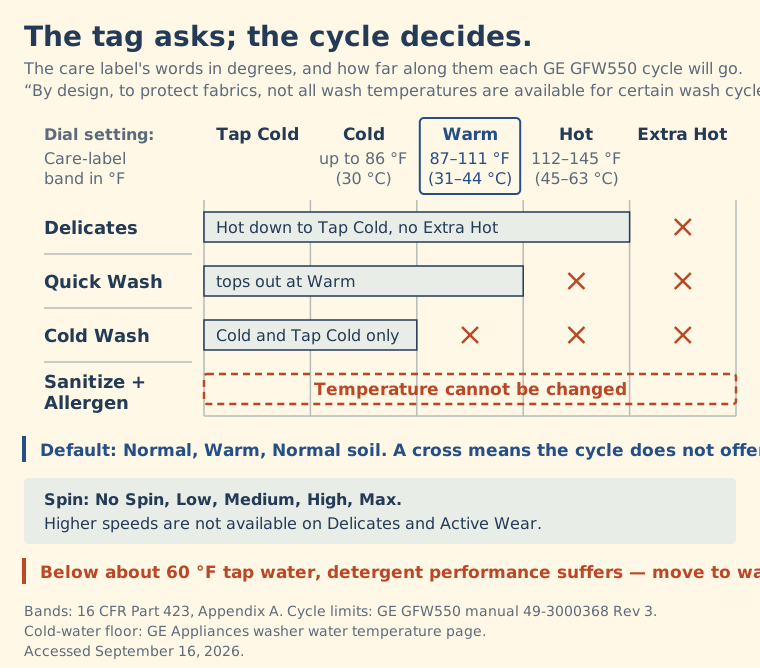
Cold means up to 86 °F (30 °C), warm means 87 to 111 °F (31 to 44 °C) and hot means 112 to 145 °F (45 to 63 °C), and you select the machine setting with the same name.
The same glossary defines the cycle words. "Delicate/gentle cycle" means "slow agitation and reduced time." "Durable press/permanent press cycle" means "cool down rinse or cold rinse before reduced spinning." Those are mechanical instructions, not temperature instructions, which is why a tag can pair "machine wash warm" with "gentle cycle" and mean both at once.
Most tags say less than you expect. The FTC's own guidance, Clothes Captioning: Complying with the Care Labeling Rule, states that "a minimum washing instruction would include a method of washing and a method of drying, like 'Machine wash. Tumble dry.'" A temperature need only be specified if regular use of hot water would harm the product. So a tag with no temperature is telling you that hot will not ruin the garment — not that you should use hot. Read the whole tag before sorting, because the rest of the symbols decide the pile too: start with reading a clothing care label.
The cycle decides which temperatures you get
The cycle names, and what the manual says each is for
Cycle names describe a load type. The manual spells out which load. In the owner's manual for GE's GFW550 front-load washer, 49-3000368 Rev 3, the descriptions are specific:
- Normal — "washing up to a full load of normally soiled cotton clothing."
- Delicates — "lingerie and special care fabrics with light soil."
- Towels — "towels, sheets, pillowcases and dish rags."
- Active Wear — "medium to lightly soiled athletic wear items of technical or synthetic fabrics."
- Quick Wash — "small loads of lightly soiled items that are needed in a hurry."
- Cold Wash — dark colors and mixed loads, using "multiple extended wash tumbling periods" to compensate for the colder water.
- Sanitize + Allergen — "heavily soiled colorfast items with the need for sanitization."
Match the load to that sentence, not to the word on the dial. A hoodie with a "gentle cycle" tag belongs on Delicates even though nobody calls a hoodie delicate.
The temperature your cycle will actually allow
Here the tag and the machine argue, and the machine wins. The GE manual's settings chart shows which temperatures each cycle offers: Delicates runs Hot down to Tap Cold but has no Extra Hot; Quick Wash tops out at Warm; Cold Wash offers only Cold and Tap Cold. The manual says this is deliberate: "By design, to protect fabrics, not all wash temperatures are available for certain wash cycles."
Two more details from the same manual change what you get.
- Sanitize + Allergen and Sanitize With Oxi have temperatures that "CANNOT be changed," and Sanitize With Oxi requires the house hot water supply to deliver "a minimum of 120 °F to ensure the effectiveness of this cycle." Only those two cycles "have been designed to meet the requirements of sanitizing effectiveness."
- "The first 10 seconds of the wash fill is always cold," whatever temperature you picked, to keep stains from setting.
Cold washing has a real floor. GE's support page on washer water temperature warns that "detergent performance can be seriously affected when used in extremely cold water, usually below 60 degrees Fahrenheit," and recommends moving to warm during winter months when the incoming cold line drops below that. If your laundry room sits on an exterior wall in January, stop defaulting to Tap Cold.
The two dials that matter more than the cycle name
Soil level is a time control, not a strength control: "Changing the Soil level increases or decreases the wash time to remove different amounts of soil." Five steps run from Extra Light to Extra Heavy. Leave it on Normal. Raise it only for genuinely dirty loads, because each step up buys more minutes and more wear.
Spin speed is the setting that protects or destroys knitwear. The GE manual offers No Spin, Low, Medium, High and Max, and notes that "higher spin speeds are not available on certain cycles, such as DELICATES and ACTIVE WEAR." Higher spin "will help reduce dry time, but may also increase the possibility of setting wrinkles on some fabrics." If a tag says do not wring, use Low.
When time is the constraint rather than fabric care, the Time Saver option on that machine "delivers a thorough clean for any size and type of load in only 35 minutes." Your model's manual overrides every general rule here, so work from the document that matches your exact model number — that is what finding the manual that matches your appliance is for.
Pull the tags on the four or five items that decide the load — the most restrictive tag governs the whole basket — and write down the temperature word and the cycle word. Translate the temperature with the table above, pick the cycle whose manual description matches the fabric, then confirm the machine offers that temperature on that cycle. If it does not, the cycle is telling you the fabric cannot take that temperature, and the cycle is right. Do that once per regular load type. Then it is automatic. Group the rest of the basket by compatible care instructions.
Sources and references
- Appendix A to Part 423 — Glossary of Standard Terms (16 CFR)Accessed 2026-09-16
- Clothes Captioning: Complying with the Care Labeling RuleAccessed 2026-09-16
- GE GFW550 Front-Load Washer Owner's Manual, 49-3000368 Rev 3Accessed 2026-09-16
- Washers Water Temperature — GE Appliances supportAccessed 2026-09-16