
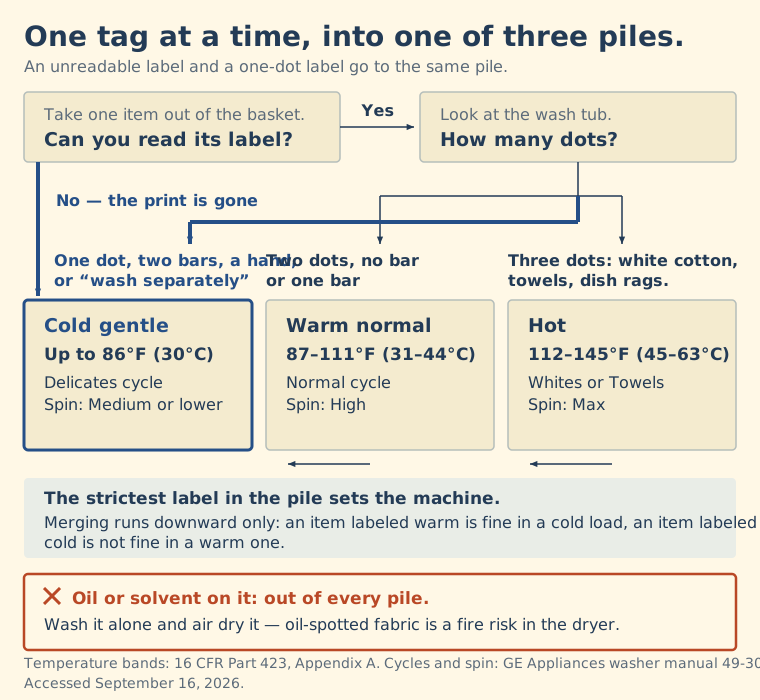
Sort a mixed basket into three piles and let the strictest label in each pile set the machine. Pile one is cold and gentle: darks, synthetics, anything marked one dot or "wash separately." Pile two is warm and normal: everyday colored cottons and blends. Pile three is hot: white cotton, towels, dish rags, heavily soiled work clothes. Merging runs downward only. An item labeled warm is fine in a cold load; an item labeled cold is not fine in a warm one.
The temperatures behind those piles are fixed by the FTC's Care Labeling Rule and its glossary of standard terms: cold is an initial water temperature up to 86°F (30°C), warm is 87 to 111°F (31 to 44°C), and hot is 112 to 145°F (45 to 63°C). A basket sorts fast once you stop reading those as adjectives and start reading them as numbers.
The three piles and the cycle each one wants
Scroll sideways to see the full table →
| Pile | Label evidence | Cycle | Temperature | Spin |
|---|---|---|---|---|
| Cold gentle | One dot, two bars, hand-wash symbol, "wash separately" | Delicates | Cold or warm | Medium or lower |
| Warm normal | Two dots, no bar or one bar | Normal | Warm | High |
| Hot | Three dots, whites and household linens | Whites or Towels | Hot | Max |
Those cycle names come from GE's front-load washer manual, and the useful constraint is which settings each cycle will even offer. On that machine the Delicates cycle exposes only Warm, Cold and Tap Cold and caps the spin at Medium — it refuses the combinations that would wreck the load. Normal offers the full ladder from Tap Cold up to Extra Hot with spin up to Max. The manual's instruction for both dials is blunt: follow the fabric manufacturer's care label when selecting the wash temperature, and again when changing the spin speed.
Spin belongs in the sort. Higher spin removes more water and shortens dry time, and the same manual warns it can also set wrinkles in some fabrics.
Color and lint are the second sort, not the first
Once care compatibility is settled, GE's manual asks for a second pass on four dimensions: color (whites, lights, colors), soil level, fabric type, and lint behavior. Towels shed. Synthetics collect. So wash lint producers such as cotton towels and socks separately from lint collectors such as synthetic garments and dress pants, which is why a bath towel does not belong in the warm pile with a black polyester dress even though both labels permit warm.
Dye transfer has a specific tell. The manual notes that when a fabric label says "wash separately," unstable dyes may be the reason, so read that phrase as a color warning rather than a fabric warning. In the federal glossary, "separately" means alone, and "with like colors" means colors of similar hue and intensity. Those are the only two phrases that force a pile to break apart.
How much actually fits in a pile
A pile is only a load if it is the right size. GE's loading examples for its front loaders give workable reference points:
- Mixed load: 6 shirts, 4 pairs of khakis or twills, 5 T-shirts, 7 pairs of boxers and 4 pairs of shorts.
- Linens: 2 bath sheets, 10 bath towels, 12 washcloths and 7 hand towels.
- Delicates: 7 bras, 7 pairs of underwear, 3 slips, 2 camisoles and 4 nightgowns, with a mesh bag recommended for the small pieces.
- Quick Wash: 2 to 3 garments only.
Four items is not a load. If that is what your cold pile comes to, hold it for the next basket rather than promoting it into the warm pile.
The items that never join a pile
Three categories stay out. However tidy the sort looks, these three go their own way.
- Anything soiled with oil or solvent. GE's manual is unambiguous: no washer completely removes oil, and oil-spotted fabric is a fire risk in the dryer. Kitchen towels carrying cooking oil get washed alone and air dried.
- Sanitize-cycle items in a house without hot enough supply. The Sanitize With Oxi cycle on that model requires the hot water connection to deliver at least 120°F to work as rated, and its temperature cannot be lowered. The manual also asks that the water heater deliver 120–140°F (48–60°C) generally.
- Garments whose label is illegible. These go into the cold gentle pile. A fourth "decide later" pile means the same shirt sits in the basket for a month. The garment label wins over any general rule, so look up the product page when you have a minute — and cold and gentle stays inside the allowance for nearly everything washable in the meantime.
A worked example: one basket, four loads
Say the basket holds two bath towels, four white undershirts, a navy work polo, two pairs of jeans, a black synthetic gym top, and a wool-blend cardigan marked hand wash.
The towels and undershirts both read hot, but the towels shed lint onto the undershirts, so they split. Towels on Towels, undershirts on Whites. Jeans and polo go warm on Normal at high spin. The gym top and cardigan go cold on Delicates at medium spin, cardigan in a mesh bag. Four loads out of one basket, decided in about four minutes of tag reading — and reading tags fast is a skill in itself, set out in what each care symbol means.
Start with whichever pile you can carry all the way through drying and putting away in one sitting. Not the biggest one. Before you press start, glance at the square symbols inside the pile you picked, because the drying decisions inside a single wash group usually split in two and that split is easiest to plan while the clothes are still in your hands. If piles keep forming but loads keep not happening, the bottleneck sits somewhere later in the chain and is worth locating before you change the sorting.
Sources and references
- 16 CFR Part 423 (Care Labeling Rule), Appendix A: Glossary of Standard TermsAccessed 2026-09-16
- GE Appliances Washers GFW850/GFW650/GFW550/GFW510/HFW350 Owner's Manual (49-3000217 Rev 5)Accessed 2026-09-16
- FTC: Care Labeling of Textile Wearing Apparel & Certain Piece Goods (rule text)Accessed 2026-09-16