
On a US care label, dots mean temperature and bars mean gentleness. That is the whole system. One dot on the wash tub means cold, an initial water temperature up to 86°F (30°C). Two dots means warm, 87 to 111°F (31 to 44°C). Three dots means hot, 112 to 145°F (45 to 63°C). Those ranges are written into the FTC's Care Labeling Rule glossary, so they mean the same thing on every covered garment sold in the United States. Count the dots, count the bars, and the garment has already told you its pile.
The rule itself lets manufacturers print symbols from ASTM D5489 in place of words, which is why so many tags now carry no sentences at all. Five symbols carry the whole instruction: the wash tub is washing, the triangle is bleaching, the square is drying, the iron is ironing, and the circle is professional care.
What the dots on the wash tub commit you to
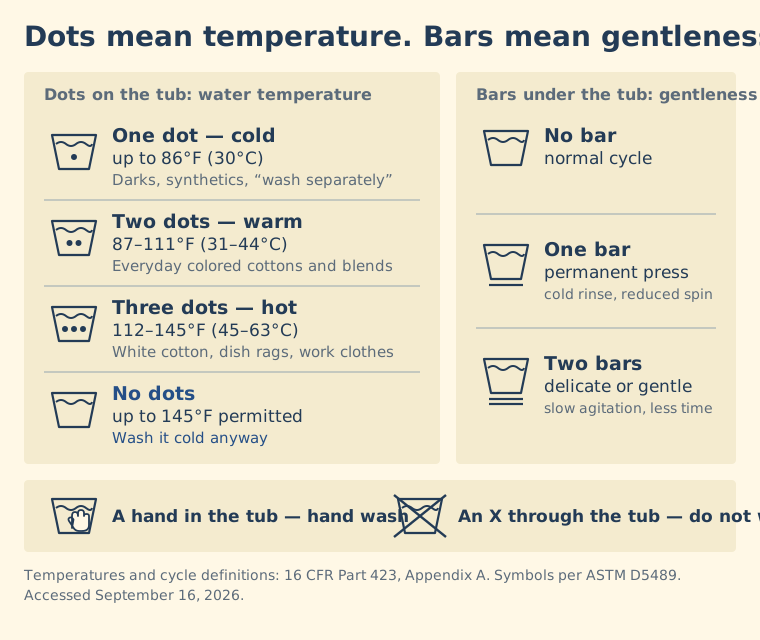
People misread the no-dot tub. A plain wash tub with no temperature marking does not mean hot. The federal glossary says that when no temperature is given, "hot water up to 145 degrees F (63 degrees C) can be regularly used." That is a ceiling, not an instruction. Washing a no-dot garment cold is never wrong; washing a one-dot garment warm is. Machine dials complicate the translation, since cycle names rarely line up with label words — worth checking against your own washer's cycle list.
Four, five and six dots exist, mostly on imported and institutional labels. A University of Florida IFAS Extension guide places that upper range between 120°F (50°C) and 200°F (95°C). On a household garment, read more than three dots as a sanitize-level instruction that most home washers reach only on a dedicated cycle.
Bars mean agitation, not heat
A bar under any symbol means be gentler, and the ladder is identical in every category.
- No bar: normal cycle.
- One bar: permanent press, defined in the glossary as a "cool down rinse or cold rinse before reduced spinning."
- Two bars: delicate or gentle — "slow agitation and reduced time."
A hand shown in the tub means hand wash: gentle squeezing rather than agitation, with hot water up to 150°F (66°C) permitted if no temperature is given. A tub with an X through it is the do-not-wash symbol, which the UF/IFAS guide glosses as a garment that "may not be safely laundered by any process" and that normally carries dry-clean instructions alongside it.
The other four symbols in one pass
Triangle (bleach). Empty means all bleaches may be used when needed. Two diagonal lines inside means only non-chlorine bleach. An X through it means no bleaches at all, oxygen boosters included.
Square (drying). A circle inside the square is a tumble dryer, and the dots work as they do on the tub: one dot is low heat, two is medium, three is high, and a filled black circle is no heat. As with the tub, a bare tumble-dry symbol permits a hot setting, so low heat is always a safe reading. A curve across the top of the square means line dry, three vertical bars means drip dry, one horizontal bar means dry flat, and a diagonal stripe in the upper corner adds "in the shade." Those shapes are a separate decision from the tub, and they are best made at the moment you unload.
Iron. One dot is 110°C (230°F), two dots is 150°C (300°F), three dots is the iron's highest setting. A crossed-out iron means do not iron; crossed-out steam lines beneath it mean dry iron only.
Circle (professional care). A letter inside tells a cleaner which solvent to use. An X means do not dryclean.
The words that still carry legal weight, and the tag you cannot read
Symbols never replaced the vocabulary, and a few words have precise definitions. "Separately" means alone — one garment, one load. "With like colors" means colors of similar hue and intensity. "Wash inside out" means turn the product inside out to protect the face of the fabric.
The rule also requires a warning, phrased with "Do not," "No" or "Only," whenever part of a normal procedure would harm the garment. Silence is therefore informative. A tag that says machine wash warm and says nothing about drying has cleared tumble drying. The garment label wins over any general rule.
Faded care labels are common on anything more than a few years old. Look for the second tag first. The fiber-content and RN-number tag is usually stitched nearby, printed on sturdier stock, and the style number on it will pull up the product page on the brand's site.
If nothing is legible, default to the strictest reading: cold water, gentle cycle, low heat or line dry. That combination sits inside the allowance for essentially every washable garment, and being wrong costs you a slightly less effective wash rather than a shrunken sweater.
Pick up the next item in the basket and answer four questions out loud. How many dots on the tub, how many bars under it, what shape is in the square, and is anything crossed out. That is the entire read. Five seconds once the symbols are familiar. Put the item in the pile that matches its tub reading — cold, warm or hot — and leave the square symbol for later. Once every item has a tub reading, you can build compatible loads out of the whole basket instead of guessing at the hamper.
Sources and references
- 16 CFR Part 423 (Care Labeling Rule), Appendix A: Glossary of Standard TermsAccessed 2026-09-16
- FTC: Care Labeling of Textile Wearing Apparel & Certain Piece Goods (rule text)Accessed 2026-09-16
- UF/IFAS Extension Jackson County: The Laundry Symbol MysteryAccessed 2026-09-16
- Tide (Procter & Gamble): How to Read Laundry SymbolsAccessed 2026-09-16