
Open the door and read the foil or metal plate on the rim of the opening. On a dishwasher, a washer and a dryer, that one habit finds the model number on nearly every major brand. GE puts the dishwasher plate on the left front inside edge, the right front inside edge, or the right side edge of the door. Whirlpool puts it on the left side of the tub frame. Bosch puts it on top of the door or on the right-hand side of the door. Type the complete string into the manufacturer's own support site, then confirm the document covers it.
Do not search the model number on a parts reseller and download whatever PDF comes back. Go to the brand's owner support page. That is the page that stays current when the document link changes.
Where the plate is, and the three numbers on it
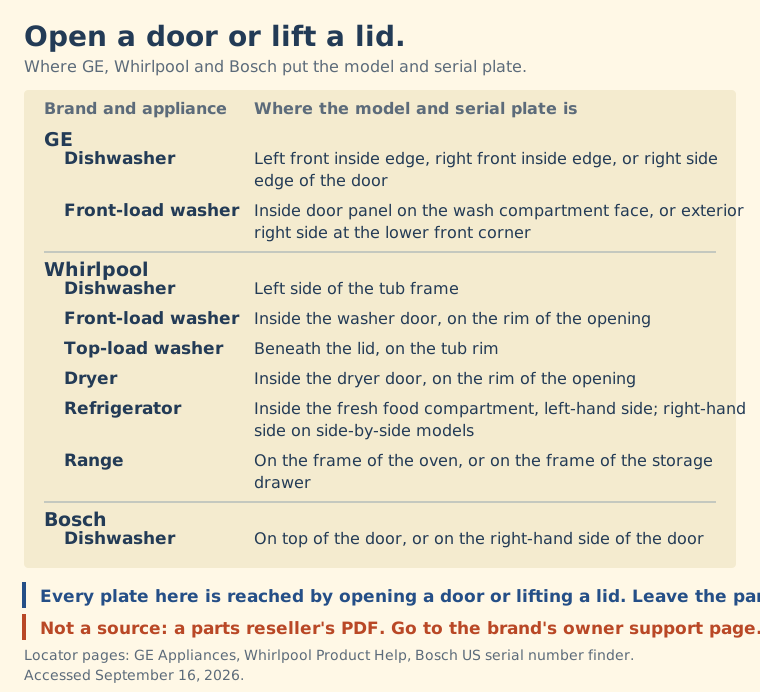
Those locations come from GE's front-load washer locator and the brand locator pages cited above. Every one of them is reachable by opening a door or lifting a lid. Leave the panels on. Leave the appliance where it stands. If a plate is genuinely unreachable, photograph the purchase receipt or the delivery paperwork instead and call the brand with that.
The plate usually carries at least two identifiers. The manual carries a third.
- Model number tells you which version of the appliance you own. This is what the support site searches on. GE's own tip catches transcription errors: GE and GE Profile model numbers always begin and end with a letter, so a trailing digit means you have misread a character.
- Serial number identifies your individual unit. It matters for warranty and recall lookups, and it is the wrong thing to type into a manual search.
- Document number identifies the booklet. The GE dishwasher owner's manual covering the PDT715 family is 49-4000270 Rev 0. Record it and you can tell later whether the PDF on your phone is the same revision as the one on the support page.
Bosch calls its model number the E-Nr, so a Bosch plate shows an E-Nr and an FD production number rather than the model/serial pair American brands use. Same job, different label.
A single manual usually covers a whole family
This is the step people skip, and it is where wrong instructions come from. Open the cover. Read the series list. The GE manual numbered 49-4000270 Rev 0 covers the GD565-665 Series, the DD700 Series and the PD*715-785 Series, and it explicitly includes the GE, GE Adora, GE Profile and GE Profile UltraFresh System ranges. Across that whole booklet, feature descriptions carry the phrase "on some models."
So when the manual describes bottle jets, a third rack or a leak-protection system, that is a statement about the family, not about your unit. Check the feature against what you can see in the machine before you act on the instructions for it. Rack and loading features are where siblings in one series diverge most, and identifying which adjustable rack features your dishwasher actually has works through that comparison.
Prove the manual is yours, pick the right document, and write down six lines
Run these against the document before you save it:
- The brand and the complete model string, suffixes included, appear on the cover or in the covered-models list.
- The page you downloaded from is the manufacturer's support domain or the document host it links to. GE, for example, serves its owner manuals from a content host linked off the model's own support page, so arriving via the model page is what tells you the PDF is the right one.
- The region and language match where the appliance was sold. A European document for a same-named model can list different cycles and different voltages.
- The control panel illustration matches what is in front of you, allowing for the variants the document names.
If any of the four fails, stop. Contact the brand with the model number and a photograph of the plate. Picking the closest-looking manual is how a household ends up following a cycle guide for a machine it does not own.
One model page typically offers several documents, and they answer different questions. The owner's manual explains cycles, options and loading. The installation instructions cover clearances, plumbing and electrical. The dimension or specification sheet is what you want when you are measuring for a replacement. The energy guide covers consumption only.
Start from the owner support page for your model and choose there. When a section of the owner's manual refers you to another document, follow the reference rather than guessing.
One short record per machine: brand, complete model number, serial number, the support-page URL, the document title and revision, and the date you checked. Six lines. That turns the next lookup into a ten-second job instead of a crawl behind the machine with a flashlight. Store those records together rather than scattered across email and photo albums; setting up a household reference folder covers a structure another adult in the house can use too. Do it once per appliance, on the day it is installed, while the paperwork is still in your hand.
Sources and references
- GE Appliances Model and Serial Number Locator - DishwashersAccessed 2026-09-16
- GE Appliances Model and Serial Number Locator - Front-Load WashersAccessed 2026-09-16
- GE Appliances Model and Serial Number LocatorAccessed 2026-09-16
- Whirlpool Product Help: Where is my Model and Serial Number Located?Accessed 2026-09-16
- Find Your Bosch Dishwasher Serial NumberAccessed 2026-09-16
- GE Dishwashers Owner's Manual 49-4000270 Rev 0 (GD*565-665, DD*700, PD*715-785 Series)Accessed 2026-09-16
- User Manual & Care for PDT715SYNFS, GE AppliancesAccessed 2026-09-16