
Look at the outside of your upper rack for a squeeze lever on each side. Levers mean a lever-adjusted rack, the mechanism Bosch calls RackMatic, and you raise or lower it with the rack still hanging in the machine. No levers almost certainly means a lift-off rack like GE's, where you pull the rack fully out, lift it clear of the end hooks on the rails, and re-hang it on a different set of roller wheels. The two procedures are not interchangeable. Forcing the GE method on a Bosch rack, or the reverse, is how racks get dropped.
Find which one you have first. Everything else about loading follows from that.
The two mechanisms, side by side
On a Bosch dishwasher with RackMatic, the sequence in the SHP78CM5N use and care manual runs: pull out the upper rack, hold the side of the rack by the top edge so it cannot drop, press in the right and left hand levers on the outside of the rack, raise or lower the rack evenly, check it is level on both sides, release the levers, and it clicks into position. The rack never leaves the machine.
On a GE dishwasher, the manual for the GD565-665, DD700 and PD*715-785 series describes the opposite: fully extend the upper rack, lift the front so the roller wheels clear the end hooks on the rails, keep pulling until the remaining wheels clear, then choose the set of rollers on the side of the rack that gives the height you want and re-hang it. GE warns that failing to align the wheels above and below the rails can result in the rack falling from the dishwasher. The rack comes all the way out.
Use the method your own manual shows. No side levers means you are removing the rack.
What three rack heights actually buy you
Bosch publishes the payoff as maximum plate diameter, which is the number that matters when a dinner plate will not go in. For a 34 in appliance fitted with a silverware basket, the SHP78CM5N manual gives:
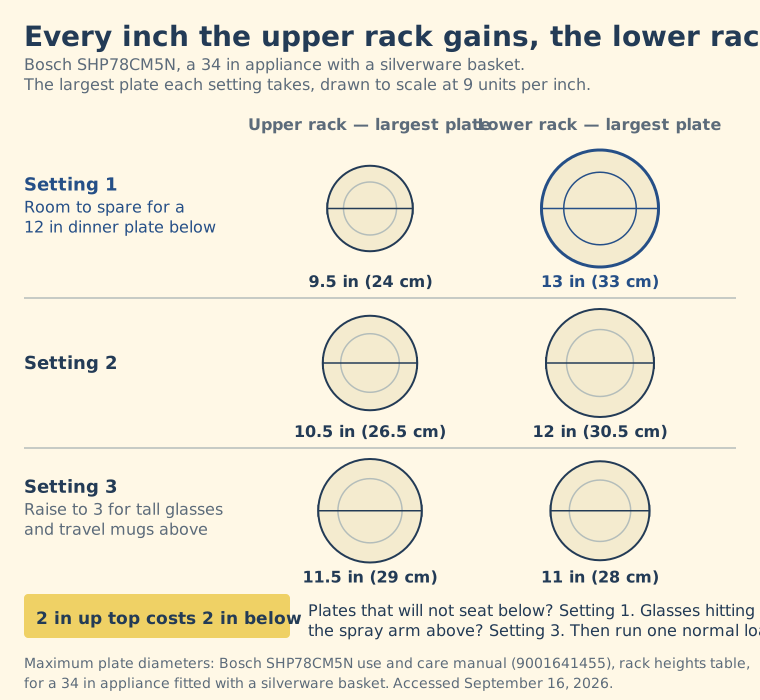
Setting 1 allows a 9.5 in (24 cm) plate in the upper rack and a 13 in (33 cm) plate in the lower, setting 2 allows 10.5 in (26.5 cm) and 12 in (30.5 cm), and setting 3 allows 11.5 in (29 cm) and 11 in (28 cm).
Read it as a trade. Not an upgrade. Moving from setting 3 to setting 1 costs 2 in of upper-rack capacity and buys 2 in in the lower rack. If 12 in dinner plates will not seat in the bottom, drop the upper rack to setting 1. If tall glasses and travel mugs are the problem on top, raise it to setting 3 and accept smaller plates below.
Check which rack setting you are on right now, because most machines are still on the factory default. Make one change. Run one normal load before you touch anything else. If you cannot find a manual that names your exact model, settle that first, using the model-number and manual lookup. And once you know what your lower rack takes at each setting, it becomes a storage question as much as a dishwasher one: the sheet pans and platters that never fit anywhere sensible are worth giving a findable home.
A third rack costs you upper-rack height
Here is the part the marketing does not say out loud. The same Bosch manual gives a second table for the same 34 in appliance when it is fitted with a silverware drawer instead of a basket, and the upper rack numbers collapse: 7 in (18 cm) at setting 1, 8 in (20.5 cm) at setting 2, 9 in (23 cm) at setting 3. The lower rack figures do not move: 13, 12 and 11 in.
That is 2.5 in of upper-rack diameter traded away across the board to make room for the third rack above it. Bosch's own fix is blunt and worth knowing: remove the third rack and large items of dishware can go in the lower rack.
Manufacturers describe the gain differently. Bosch's spec sheet for the 800 Series SHP878ZD5N lists the third rack as a "Flexible 3rd Rack" with fold-down sides that adds 30% more loading area compared with a Bosch dishwasher with two racks, on a 16-place-setting machine. GE's manual is more specific about intent: its third rack is the recommended location for silverware and large utensils, and it is removable so extra-large items can go in the upper rack. Bosch's product page for the same model names both the Flexible 3rd Rack and the RackMatic adjustable upper rack, which is the pairing to look for on a spec list. Use the third rack for flatware and cooking tools, and pull it out on stockpot nights.
Three parts that are not rack adjustments
People lump these in with "adjustable racks" and then hunt for a height setting that does not exist.
- Flip tines. A hinged group of upright supports in the lower rack. Push the lever forward and the tines fold flat, which is what you do for pans, bowls and mixing bowls, not for plates. GE calls the equivalent fold-down tines and fits them on some models only.
- Cup shelf. The small hinged ledge along the side of the upper rack, for cups, small glasses, or long items like cooking spoons and serving cutlery. It folds down when you do not want it. It has no height setting of its own.
- Silverware drawer. The shallow top tray itself. On Bosch it reorganizes rather than moves: fold down the side shelves and the front tines to make room for longer or wider utensils, then fold the side shelf back up until it clicks.
If a part on your machine matches none of these and appears in no diagram in your manual, photograph it and ask the brand rather than working it loose. Your model's manual overrides any general rule here, and a manual covering a whole series will qualify many features with "on some models."
Sources and references
- Bosch SHP78CM5N Dishwasher Use and Care Manual, en-us (9001641455)Accessed 2026-09-16
- Bosch 800 Series SHP878ZD5N 24" Pocket Handle Dishwasher spec sheetAccessed 2026-09-16
- GE Dishwashers Owner's Manual 49-4000270 Rev 0 (GD*565-665, DD*700, PD*715-785 Series)Accessed 2026-09-16
- SHP878ZD5N Dishwasher product page, BOSCH USAccessed 2026-09-16