
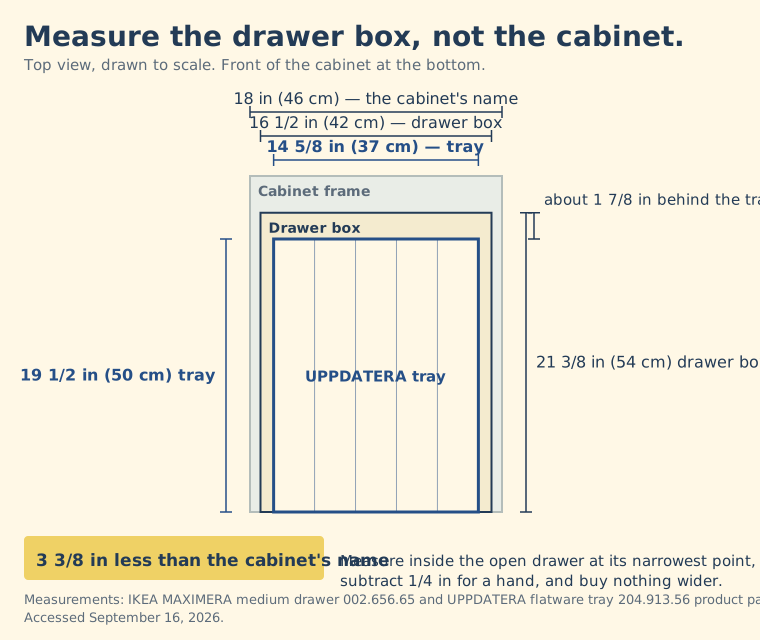
Budget about 3 3/8 inches less usable drawer width than the cabinet is called. An 18-inch base cabinet takes an IKEA MAXIMERA medium drawer built for that 18 x 24 in (46 x 61 cm) cabinet frame, and the drawer box itself measures 16 1/2 x 21 3/8 in (42 x 54 cm) overall. The UPPDATERA flatware tray IKEA lists for that same 18-inch frame is 14 5/8 in (37 cm) wide. The cabinet frame, the drawer sides and the running clearance eat the difference. So measure the inside of the open drawer at its narrowest point, subtract 1/4 in for a hand's clearance, and buy nothing wider than that number.
Then read the organizer's measurements section, not its title. The titles round.
The titles round, the specs do not
IKEA sells one UPPDATERA tray as "15x19 1/2 inch" and another as "6x19 1/2 inch". Their actual published measurements are 14 5/8 x 19 1/2 x 2 1/4 in (37 x 50 x 6 cm) and 5 3/4 x 19 1/2 x 2 in (15 x 50 x 5 cm). Both names round the width up, by 3/8 in on one and 1/4 in on the other.
That rounding is the difference between an organizer that drops in and one that has to be forced past a drawer slide. Measure 14 3/4 in of usable width, read 15 in on the listing, and you still know nothing. Open the measurements section. The real figure is in there.
Scroll sideways to see the full table →
| Organizer | Published size | Depth | Height |
|---|---|---|---|
| IKEA UPPDATERA flatware tray (204.913.56) | 14 5/8 in (37 cm) wide | 19 1/2 in (50 cm) | 2 1/4 in (6 cm) |
| IKEA UPPDATERA utensil tray (604.913.64) | 5 3/4 in (15 cm) wide | 19 1/2 in (50 cm) | 2 in (5 cm) |
| Joseph Joseph DrawerStore expanding cutlery organizer | 13 3/8 in (34 cm) wide closed, expands | 15 7/8 in (40.5 cm) | 2 1/2 in (6.5 cm) |
The four numbers to measure, and why height is the one that fails
Pull the drawer all the way out and measure with it open. Record:
- Usable width at the narrowest point. Drawer sides are often not parallel to the front, and metal slide housings can intrude an eighth of an inch on each side near the back. Take the smallest reading, not the widest.
- Usable depth front to back, inside the front panel and stopping at the back wall. It runs much shorter than the cabinet frame: the MAXIMERA medium drawer is itself 21 3/8 in deep, and a 19 1/2 in UPPDATERA tray inside it leaves under 2 in (about 1 7/8 in) behind it.
- Closing clearance, not side-wall height. A drawer under a countertop, a pull-out shelf or a fixed rail passes under something on the way in. Measure the lowest obstruction along that path. The MAXIMERA medium drawer is 5 5/8 in high overall, but a tall organizer has to clear the structure above, not the drawer's own wall.
- Weight, if you are loading it heavily. IKEA rates that MAXIMERA medium drawer at a 55 lb 2 oz (25 kg) maximum load, which a drawer full of cast-iron trivets and knife blocks can approach.
Use one unit throughout. Mixing 14 5/8 in from a listing with 37.2 cm from your tape measure is how a quarter inch disappears.
Most drawer organizer returns are height failures, not width failures. The Joseph Joseph DrawerStore expanding organizer specifies a minimum drawer height of 3 in (7.5 cm) even though the tray itself stands 2 1/2 in (6.5 cm) tall, because the contents stand proud of the compartments. A 2 1/4 in UPPDATERA tray holding a whisk has the same problem.
Test it before you buy. Put the tallest utensil you intend to store flat in the empty drawer, stack the organizer's quoted height underneath it in your head, and close the drawer slowly. If anything catches, you need a shallower tray or a different drawer for that utensil.
Expandable trays solve width, not depth
An expanding organizer such as the Joseph Joseph DrawerStore is 13 3/8 in (34 cm) wide closed and widens from there, with five deep compartments, a long section for skewers, and adjustable side trays. That solves the awkward case where your usable width falls between two fixed sizes, which is common in older kitchens with non-standard cabinet runs.
Depth is another matter. At 15 7/8 in (40.5 cm) deep, dropped into the MAXIMERA medium drawer's actual 21 3/8 in depth, it leaves about 5 1/2 in of loose space behind it that will collect small items unless you put something there on purpose. Use a fixed-size tray when your width matches a published size, and an expanding one when it does not.
Cut the template before you order
Draw the organizer's real rectangle on a sheet of paper or a flattened cereal box, cut it out, and lay it in the drawer. Ninety seconds, total. That catches the two things a spreadsheet will not: a rounded corner or slide bracket that the rectangle overlaps, and the fact that you cannot get your fingers around the edge of a tray that fills the drawer edge to edge.
Then lay your actual utensils on the template, in the compartments they would occupy. A tray can fit the drawer perfectly and still be wrong if its longest compartment is 9 in and your tongs are 12. If one smaller tray plus an open section works better than one wall-to-wall organizer, take that. An undivided zone for the odd-shaped things usually beats another divider.
If the drawer is overfull rather than badly divided, an organizer will not fix it, and the faster route is resetting the drawer one category at a time before you spend anything. For the same measure-first logic applied to food storage, see comparing container dimensions with stated capacity, and for cabinets where the back row disappears, plan a deep cabinet from above.
Sources and references
- IKEA UPPDATERA utensil tray, white, 604.913.64Accessed 2026-09-16
- IKEA UPPDATERA flatware tray, light bamboo, 204.913.56Accessed 2026-09-16
- IKEA MAXIMERA drawer, medium, white, 18x24", 002.656.65Accessed 2026-09-16
- Joseph Joseph DrawerStore Expanding Cutlery, Utensil OrganizerAccessed 2026-09-16