
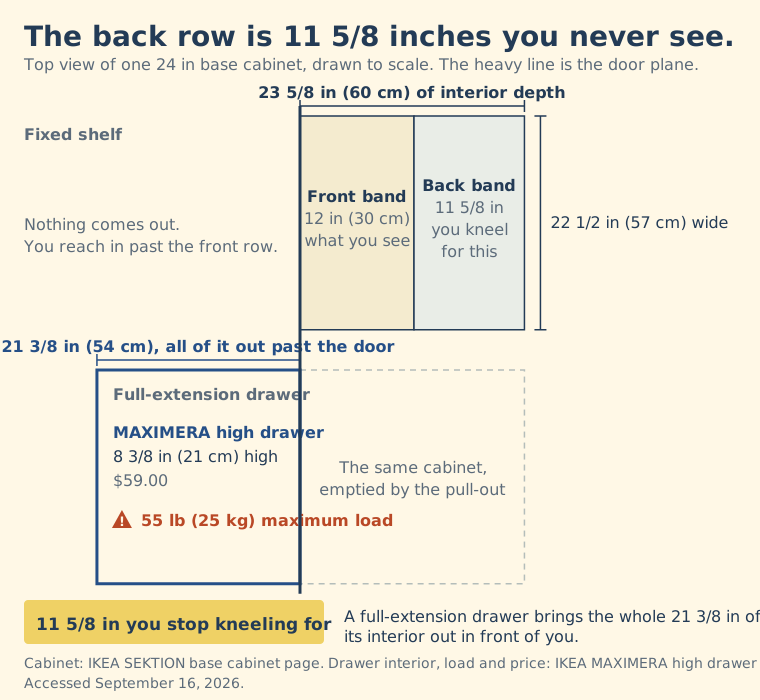
Replace the fixed shelf with one full-extension pull-out drawer, and the back row stops disappearing. A standard American base cabinet is 24 in (61 cm) deep with about 23 5/8 in (60 cm) of usable interior, and behind a hinged door the rear half of that depth can only be reached by kneeling and groping past whatever sits in front. A drawer brings the whole depth out to you: an IKEA MAXIMERA high drawer for a 24 x 24 in cabinet gives an interior of 22 1/2 x 21 3/8 x 8 3/8 in (57 x 54 x 21 cm), carries a maximum load of 55 lb (25 kg), pulls out all the way, and lists at $59.00. Not buying hardware? The alternative is equally definite: give the back row exactly one job, and never mix jobs front to back.
Why the back row disappears
Three measurements explain it. The cabinet interior is 23 5/8 in deep. The door opening is narrower than the cabinet box, so a 24-inch-wide SEKTION frame with 3/4 in walls gives 22 1/2 in (57 cm) of clear interior width, and less than that once a face frame or hinge hardware intrudes. And the shelf sits at roughly knee-to-hip height, so you look down at the front row and see nothing behind it.
The National Kitchen & Bath Association's access standard puts frequently used items 15 to 48 in (381-1219 mm) above the floor, and its storage guideline discounts anything above 84 in (2134 mm) to the "miscellaneous" category. A deep base shelf fails a related test: inside the reach range vertically, outside it horizontally. Once an item sits more than about an arm's length back on a fixed shelf, you handle it like high storage - occasionally, reluctantly, and only when you already know it is there.
Three fixes, with their actual numbers
Scroll sideways to see the full table →
| Fix | What it gives you | Fits | Price |
|---|---|---|---|
| Full-extension drawer (IKEA MAXIMERA, high, 24x24 in) | 22 1/2 x 21 3/8 x 8 3/8 in interior, 55 lb load, soft-close, pulls out fully | A 24 in base cabinet frame plus a front | $59.00 |
| Corner carousel (IKEA UTRUSTA, 38 in frame) | Two rotating trays, 30 3/4 in (78 cm) diameter, 44 lb (20 kg) per shelf, upper tray adjustable 19 5/8 to 29 7/8 in | A blind corner base cabinet | $110.00 |
| Vertical tray dividers (Rev-A-Shelf 597) | Slots 3/4 in wide x 20 in deep, 18 in high for base cabinets, four screw-in clips each | Any cabinet with at least 20 in of usable depth | Sold per divider |
The contents decide which fix you need
Pick by what the cabinet holds. Choose the drawer when the contents are heavy and varied - pots, mixing bowls, small appliances - because full extension is the only thing that makes the rear 10 inches usable for objects you cannot see through. Choose the carousel when the cabinet is a blind corner, where a drawer cannot reach the dead space at all. Choose dividers when the contents are flat and rigid, which is the same logic that gets baking sheets and platters out of a stack.
If you are not buying anything, give the back row one job
Hardware is optional. The rule is not. Load the cabinet in two bands, and decide the band by frequency instead of by size:
- Front band, the first 12 in (30 cm): everything used weekly. Nothing here is stacked more than two deep.
- Back band, the remaining 11 5/8 in (30 cm): one category only, and one you can name from the doorway - backstock, the second set, the seasonal pieces.
The single-category rule is what makes it work. You do not need to see the back row if you can say what is in it. "Back of the left sink cabinet is spare cleaning refills" is a retrievable fact; "back of the left sink cabinet is miscellaneous" is not. Write the category on a strip of painter's tape inside the door. It costs nothing and survives every other person in the household.
A worked example: the cabinet left of the sink
Take a 30 in wide, 24 in deep base cabinet as the example, one fixed shelf, doors that open to about 26 in of clear width. Before: two stockpots in front, and behind them a slow cooker, three vases, a bag of dishwasher tablets, and a stand mixer bowl - all of it invisible.
The change: one 30-inch full-extension drawer in the lower half for the stockpots and the slow cooker, since combined they sit well under the 55 lb limit. The upper half keeps the fixed shelf and gets one category behind the front row: dishwasher and dish-soap backstock, labeled on the door. The vases move out of the kitchen entirely, because they are not a kitchen category and were only there because the space was dark enough to hide them.
The test afterward is retrieval, not appearance. Can you take the slow cooker out with one hand while holding something in the other? With a full-extension drawer, yes. With a fixed shelf and two stockpots in front, never.
Your own cabinet starts the same way. Empty it completely and measure three numbers: interior width, interior depth, and the clear opening width with the doors at 90 degrees. That last one is what an organizer has to pass through, and it is always smaller than the box. Under 20 in of depth? Skip tray dividers. A blind corner? Price out the carousel from the table above rather than the drawer.
Then sort what is on the floor into weekly, monthly, and seasonal. Weekly goes in the front band. Seasonal leaves the cabinet, and often the kitchen. Monthly becomes the single named category for the back band. Anything that does not fit those three buckets is an item without a home yet, and it needs its own decision rather than a place in the back row. If you decide on a pull-out, take the three measurements to the product page and compare them with the stated minimum opening before ordering, exactly as you would when sizing a drawer organizer.
Sources and references
- MAXIMERA drawer, high, white, 24x24" - IKEAAccessed 2026-09-16
- SEKTION base cabinet, white, 24x24x30" - IKEAAccessed 2026-09-16
- UTRUSTA corner base cabinet carousel, gray, 38" - IKEAAccessed 2026-09-16
- Rev-A-Shelf 597 Series Tray Dividers with Clips (specification sheet)Accessed 2026-09-16
- NKBA Kitchen Planning Guidelines with Access StandardsAccessed 2026-09-16