
Store baking sheets, cutting boards, cooling racks and large platters upright on edge in a full-depth base cabinet, separated by vertical tray dividers, with the pieces you use weekly between 15 and 48 inches (38-122 cm) off the floor. One measurement decides it. A standard half-sheet pan is 18 x 13 x 1 in (46 x 33 x 2.5 cm), and a common restaurant-style oval platter is 18 x 13 x 1 3/4 in (46 x 33 x 4.4 cm) - the same footprint. Neither lies flat in a wall cabinet 14 3/4 in (37 cm) deep, and stacked flat in a base cabinet they bury whatever sits underneath. On edge, each piece takes about one inch (2.5 cm) of cabinet width and comes out with one hand.
Your pans are one of three standard sizes
American sheet pans come in three standard sizes descended from commercial bakeware. Prices below are WebstaurantStore list prices for Vollrath Wear-Ever pans, checked September 16, 2026.
Scroll sideways to see the full table →
| Pan | Dimensions | Price | Where it fits on edge |
|---|---|---|---|
| Quarter sheet (5220) | 13 x 9 1/2 x 1 1/8 in (33 x 24 x 2.9 cm) | $10.90 | Any base cabinet; a 15 in wall cabinet |
| Half sheet (5314) | 18 x 13 x 1 in (46 x 33 x 2.5 cm) | $27.40 | Base cabinet, front to back |
| Full sheet (9002) | 26 x 18 x 1 in (66 x 46 x 2.5 cm) | $19.10 | Only side to side, in a 30 in cabinet |
The full sheet only fits sideways, in a 30-inch cabinet
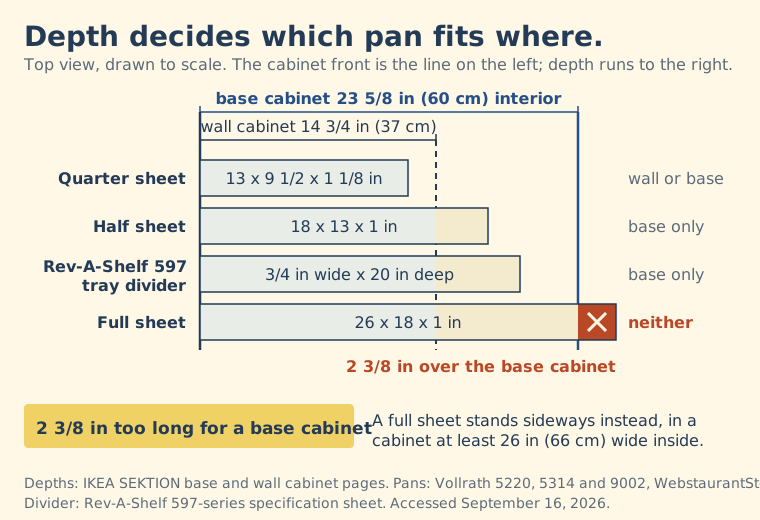
That last row is the one people get wrong. The interior of a standard base cabinet runs about 23 5/8 in (60 cm) deep - an IKEA SEKTION base cabinet frame measures 24 x 24 x 30 in with a 23 5/8 in depth behind the suspension rail. A full sheet pan's 26-inch length will not go front to back in that space. It has to stand sideways, which means a cabinet at least 26 in (66 cm) wide inside. A 30-inch-wide frame with 3/4 in walls gives you 28 1/2 in (72 cm) of interior width, so it clears. If your widest cabinet is 24 in, skip full sheets. Buy two half sheets instead. Run them in the same oven.
The divider that does the work costs less than the pan
Rev-A-Shelf's 597-series tray dividers are the standard fix. Each divider is 3/4 in (19 mm) wide and 20 in (508 mm) deep, in a 12 in (305 mm) height for wall cabinets or an 18 in (458 mm) height for base cabinets, and mounts with four screw-in clips.
The 20-inch depth is the number that picks your cabinet. A base cabinet at 23 5/8 in deep takes the divider with room for the screws; a 14 3/4 in wall cabinet cannot take it at all. So if your bakeware currently lives above the counter, it is in the wrong cabinet, and no organizer will fix that.
Set the slots by content, not by even spacing. Allow about 1 1/2 in (4 cm) per slot for sheet pans and cooling racks, and 2 1/2 to 3 in (6-8 cm) for stoneware platters and cast-iron griddles, which are thicker and chip against each other. One piece per slot. The moment two pans share a slot, you are back to lifting one to reach the other.
Height decides what you actually reach for
The National Kitchen & Bath Association's access standard is to plan storage of frequently used items 15 to 48 in (381 to 1219 mm) above the floor, and its storage guideline counts any storage more than 84 in (2134 mm) above the floor in the miscellaneous category only - the association's own way of saying that a high shelf is not real storage.
Use that as the sorting rule. Anything you bake with weekly goes in a base cabinet within arm's reach of the oven. Anything seasonal - the full sheet, the turkey platter, the tiered stand - goes above the refrigerator or on the top shelf, and you accept a step stool twice a year. The same logic governs the deep cabinets in the rest of the kitchen.
A worked example: the 30-inch cabinet beside the oven
Take a 30 in wide base cabinet with its shelf removed, giving 28 1/2 in of interior width and 23 5/8 in of depth. Install four 18-inch dividers, creating five slots. A realistic load:
- Slot 1, 1 1/2 in: two half-sheet pans, back to back.
- Slot 2, 1 1/2 in: a wire cooling rack and a perforated pan.
- Slot 3, 3 in: the 18 x 13 in melamine platter (about $15.75 each) plus a wooden board.
- Slot 4, 3 in: two end-grain cutting boards.
- Slot 5, the remaining 19 in: the roasting pan and the muffin tins, stacked flat because they nest.
Four dividers and an afternoon. Nothing was thrown away, and the platter that used to sit on top of the refrigerator now comes out without moving anything else.
Pull every flat piece out of the kitchen and lay it on the counter. Measure the longest one: anything over 23 in (58 cm) needs a cabinet wide enough to hold it sideways. Then measure the interior depth of the candidate base cabinet. Under 20 in (51 cm) and tray dividers will not mount, so use a magazine-style file box or a tension rod instead. Count slots against pieces before you order, and decide right there which two pieces are going up high. A piece with no slot and no high shelf does not have a home yet, so that item needs its own decision rather than a spot on the counter - and what earns counter space at all is a separate question worth settling first.
Sources and references
- Vollrath 5314 Wear-Ever Half Size 13 Gauge 13" x 18" Aluminum Bun / Sheet PanAccessed 2026-09-16
- Vollrath 9002 Wear-Ever Full Size 18 Gauge 18" x 26" Aluminum Bun / Sheet PanAccessed 2026-09-16
- Vollrath 5220 Wear-Ever Quarter Size 16 Gauge 9 1/2" x 13" Aluminum Bun / Sheet PanAccessed 2026-09-16
- GET ML-15-W Milano 18" x 13" White Oval PlatterAccessed 2026-09-16
- Rev-A-Shelf 597 Series Tray Dividers with Clips (specification sheet)Accessed 2026-09-16
- SEKTION base cabinet, white, 24x24x30" - IKEAAccessed 2026-09-16
- SEKTION wall cabinet, white, 30x14 3/4x30" - IKEAAccessed 2026-09-16
- NKBA Kitchen Planning Guidelines with Access StandardsAccessed 2026-09-16