
Count the pantry one shelf at a time before you write a shopping list. It takes 15 minutes. Record two things for every item: how many, and how long it has been open. The second number is what changes the list. Opened dry pasta keeps about 1 year, opened white flour 6 to 8 months, and opened vegetable oil only 3 to 5 months in the pantry, according to NDSU Extension's Food Storage Guide. "We have some" and "we have some we will actually use" are different answers, and only the count tells you which one you are holding.
Opened changes the number, sometimes twelvefold
An open bag and a sealed one are not the same stock. All figures below are NDSU Extension's; the pantry temperature they assume, around 70°F (21°C), comes from Ohio State University Extension.
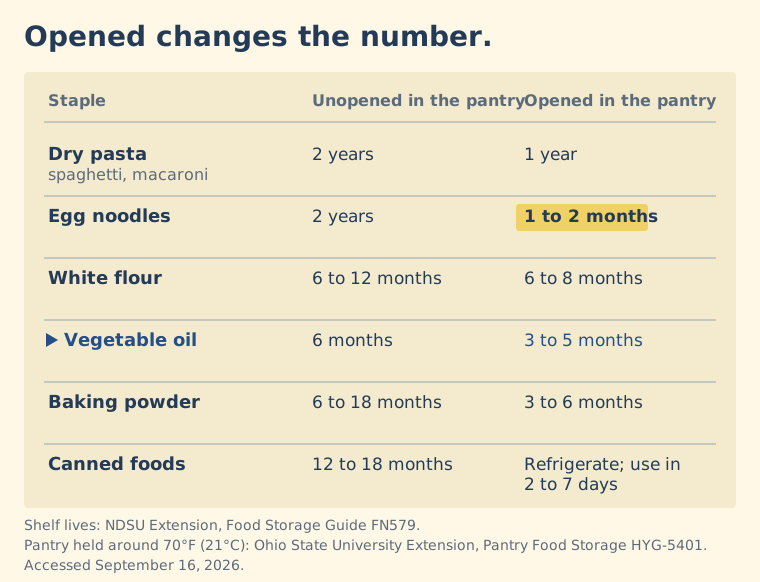
Two staples ignore the question: rice, white, brown or wild, keeps 1 to 2 years whether the bag is open or sealed, and dried peas and beans keep 12 months either way, airtight once opened.
Three lines deserve a second look. Egg noodles fall from 2 years to 1 to 2 months once the bag is open, a twelve-fold change. Oil is the shortest-lived thing most households treat as permanent. And an opened can is not pantry stock at all: NDSU gives opened canned vegetables 2 days and opened canned fruit 5 to 7 days, refrigerated in a glass or plastic container rather than the can.
Ohio State University Extension adds three more from the same shelf: ground spices and herbs keep about 6 months, whole spices 1 to 2 years, and an opened box of ready-to-eat cereal 2 to 3 months.
Count one shelf, and trust your marker over the printed date
One shelf at a time. A single shelf finishes in a sitting, which is why it gets done at all.
- Pick the shelf you reach for most often and clear a 2-foot (61 cm) landing strip of counter next to it.
- Bring everything forward to the shelf edge in one pass, left to right, including the back row.
- Write one line per item: name, number of packages, and open or unopened.
- For anything already open, write the month on the package in permanent marker. If you cannot remember, write the current month and start the clock there.
- Sort each line into three piles on paper: enough for what we plan to cook, check against the recipe, buy.
- Photograph the shelf before you close it. The photo settles arguments at the store faster than the list does.
Only the "buy" pile reaches the shopping list. Items in "check" stay off it until someone opens the recipe and the package.
Three kinds of date get printed on a package. All three of the common dates describe quality. Penn State Extension states that "Best if Used By" means recommended for best flavor or quality, "Use-By" is the last recommended date for peak quality, and "Sell-By" tells the store how long to display the item. The FDA and USDA require a date on exactly one product: infant formula.
Two consequences at the shelf. A sealed box of pasta three months past its printed date is still stock, so count it. And a date printed at the factory says nothing about the bottle of oil you opened in March, which is why your own marker beats the label.
Where you store it changes every number in the table
Ohio State Extension's storage times assume a pantry at 70°F (21°C), and it warns that canned food stored above 70°F has a shorter shelf life. NDSU says the same thing in plainer words: keep staples in cool cabinets and away from appliances that produce heat.
Two cabinets break this rule. The one above the range and the one beside the dishwasher both run warm. If those are your pantry, move the heat-sensitive items out first, in this order: cooking oil, whole-grain flour, ground spices, then anything with chocolate or nuts in it. Dry pasta, rice and canned goods take the warm cabinet best, so they are the ones to leave behind.
Depth is the other quiet problem. A back row you cannot see is a back row you buy twice. That is a layout question rather than a counting one, and organizing one deep cabinet without losing the back row deals with the risers and bins that fix it.
The list comes off the count, not off memory
Write the shopping list beside the count, not an hour later at the door. Every line on the list traces back to a line in the count: a "buy" item, or a "check" item someone has since checked.
Meals follow the count, not the reverse. A use-what-you-have meal list works from the same page you just filled. Anything that ran out but is not needed this week goes on a standing restock note instead of this trip's list, which is what a household replenishment list is for.
Choose the shelf that holds pasta, rice and canned tomatoes. That is where duplicates hide and where the shelf lives run longest. Count it, mark every opened package with the month, and photograph it. Then check the oil. A bottle open longer than 5 months is the one item on that shelf most likely to need replacing however full it looks. Next week, take the shelf with the flour and the baking powder, the two staples whose numbers move fastest once opened. Two shelves and 30 minutes cover most of what a household buys twice.
Sources and references
- Food Storage Guide (FN579), NDSU ExtensionAccessed 2026-09-16
- Pantry Food Storage, HYG-5401, Ohio State University Extension (Ohioline)Accessed 2026-09-16
- Are "Best if Used-By" and "Use-By" Dates for Food Quality or Food Safety?, Penn State ExtensionAccessed 2026-09-16