
Move the item to the nearest open spot between 15 and 48 inches (38–122 cm) above the floor, within one arm's reach of where it gets used, and take something out of that spot rather than buying a container to squeeze it in. An item that never gets put away rarely has a motivation problem. It has a height problem, a depth problem, or a two-hands problem. Each one is measurable. Four minutes with a tape measure settles which.
The reach band that decides whether an item comes back
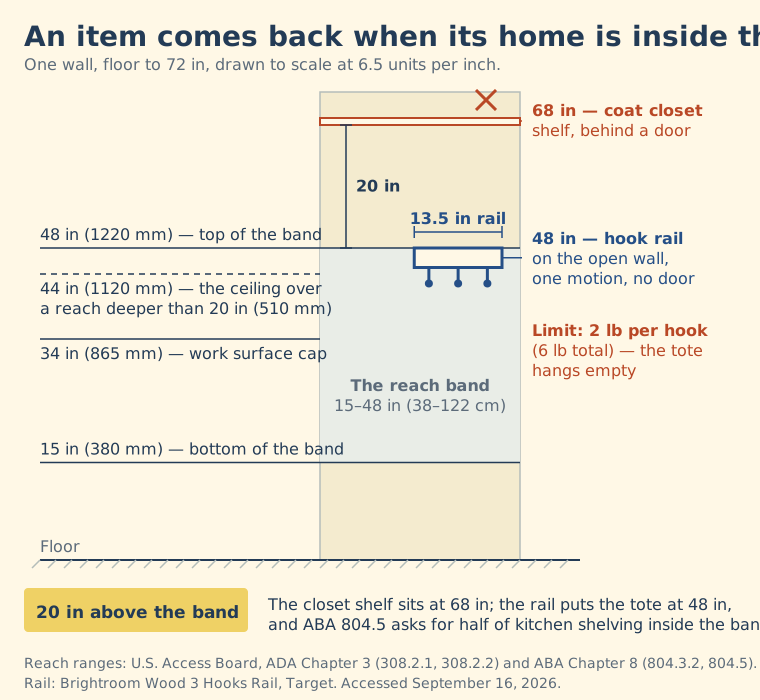
The U.S. Access Board's ADA standards put numbers on the zone a person can use without repositioning. Section 308.2.1 sets the unobstructed high forward reach at 48 inches (1220 mm) maximum and the low forward reach at 15 inches (380 mm) minimum above the finished floor. Section 308.2.2 drops that ceiling to 44 in (1120 mm) the moment you have to reach across something deeper than 20 in (510 mm) — a kitchen counter, a bed, a console table. Side reach follows the same pattern: 48 in unobstructed, 46 in (1170 mm) once the reach depth passes 10 in (255 mm).
Kitchens have a published version of the same rule. The Architectural Barriers Act standards require that at least 50 percent of shelf space in kitchen storage fall inside that reach range (804.5), and cap an accessible work surface at 34 in (865 mm) above the floor (804.3.2).
These are accessibility minimums, not decorating rules. They still describe the envelope every person in your house is working inside. So measure the spot the item is supposed to go. Floor to shelf: over 48 in, under 15 in, or behind 20 in of counter you have to lean across, and you have found the reason.
Three questions that name the actual failure
Ask them in this order and stop at the first "no."
- Does it have one agreed home, in words two people would say the same way? If one person means the hall closet's top shelf and another means the basket on its floor, there is no home. Say the exact shelf out loud and write it on a label.
- Is that home inside 15–48 in, and is there empty space there right now? A full shelf is not a home. If the shelf is full, the fix is subtraction: one item leaves for every item that joins.
- Does putting it back take more than one motion with one hand? Opening a door, moving a stack and lifting a lid is three motions. An open bin at 40 in is one.
The fix differs by question. Question 1 fails, you write a label. Question 2 fails, you remove something. Question 3 fails, you take the lid off, or move the item to open shelving and take the door out of the equation. Do not apply all three at once, or you will not know which one worked.
A worked example: the tote bag that lives on a dining chair
Say the item is a canvas tote that gets dropped on a chair every evening. Its official home is the coat closet's shelf, measured at 68 in — 20 in above the usable band, behind a door.
A Brightroom Wood 3 Hooks Rail at Target is 13.5 in long by 3 in wide by 3 in deep, holds 6 lb total with a 2 lb limit per hook, and costs $15.00 (September 2026). Mounted on the wall beside the dining room door at 48 in, it puts the tote inside the reach band, on an open wall, in one motion. The 2 lb per-hook limit is the real constraint. An empty canvas tote hangs fine; the same tote with a laptop and a water bottle in it does not. So the tote hangs empty and the laptop gets its own spot, which is a second item and needs its own pass through the three questions.
No wall available? The same logic works on a shelf you already own. What changes is the number you have to hit, not the method.
Fit the item before you buy a container
Utah State University Extension's decluttering guidance warns specifically against buying storage containers to hide clutter rather than reducing what you own. Measure first, then buy. A container bought before the measurement creates a second problem, because outside and inside dimensions are not the same number. A Sterilite 6-quart stackable box sold at Target measures 13 5/8 x 8 1/4 x 4 7/8 in on the outside but only 11 1/4 x 6 1/8 x 4 1/4 in on the inside. The item you are storing has 2 3/8 in less length to work with than the shelf math suggested. Work that difference out first, the way you would before comparing container dimensions with stated capacity or measuring for a drawer organizer.
Use a container only when the item is genuinely a group — six charging cables, a stack of dish towels — and the group needs a boundary. A single object that keeps getting left out needs a place, not a box.
Pick the one item that has annoyed you most this week. Measure floor to shelf at its current official home. Write the number down. If it lands outside 15–48 in, walk the room and find the nearest surface or wall inside the band that sits within about six feet of where the item is used. Clear one thing off it — move that thing, donate it, or add it to the pile you already have a next step for. Put the item in the cleared spot and leave it a week, with no container. Goes back on its own five nights out of seven, and the location was the whole problem. If it does not, the failure is question 1 or question 3, and you can now fix exactly one of them.
Sources and references
- U.S. Access Board — ADA Standards, Chapter 3: Building Blocks (Section 308 Reach Ranges)Accessed 2026-09-16
- U.S. Access Board — ABA Standards, Chapter 8: Special Rooms, Spaces, and Elements (Kitchens)Accessed 2026-09-16
- Sterilite 12 Pack 6 Qt Stackable Storage Box — TargetAccessed 2026-09-16
- Brightroom Wood 3 Hooks Rail Natural — TargetAccessed 2026-09-16
- Ask an Expert: Spring Clean Your Life — Less Is More, Utah State University ExtensionAccessed 2026-09-16