
Plan the fastest-spoiling food first and stop at four dinners. Raw ground meat and raw poultry keep 1 to 2 days in the refrigerator at 32 to 40°F (0 to 4°C), beef steaks and roasts 3 to 5 days, cooked leftovers 3 to 4 days. So the refrigerator sets the order of the list, not your mood: whatever has the shortest clock gets Monday. Four planned dinners plus two pantry-only backstops covers a normal week for most households, because at least two nights change.
The shortest clock cooks first
Lay the week against the clock on each package. These refrigerator and freezer times come from NDSU Extension's Food Storage Guide, with the leftover figures from University of Nebraska–Lincoln Extension.
Refrigerated at 32 to 40°F, ground beef or ground poultry, chicken or turkey pieces, lean fish fillets (cod, flounder, haddock, halibut) and fatty fish fillets (salmon, mullet, smelt) all keep 1 to 2 days and belong on night 1, or night 2 for the poultry; beef steaks, chops or roasts keep 3 to 5 days and hold for nights 2 to 4; precooked bratwurst keeps 5 to 7 days and holds for nights 3 to 6; cooked leftovers keep 3 to 4 days and are used within 3 days; and frozen at 0°F those same items keep 3 to 4 months, 9 months, 6 to 10 months, 2 to 3 months, 4 to 12 months, 2 to 3 months and 2 to 6 months.
The rule that falls out of the table is short. Anything you cannot cook inside its refrigerator window goes into the freezer on shopping day, not on the day it turns. Freezing 1 pound (450 g) of ground beef the hour you get home costs nothing. Deciding on Wednesday costs the whole package.
Four dinners, not seven
Plan four. Leave three nights open. Leftovers from a doubled batch take one of those nights, a plan changes on another, and the third absorbs a late workday or a takeout decision that was going to happen anyway. Shopping for seven dinners is how produce and ground meat end up in the trash with the plan still stuck to the refrigerator door.
University of Illinois Extension asks four questions before you write anything down: how many days you are shopping for, how many people are eating, how much time you will have, and what is already in the pantry. Answer the fourth with a count rather than a guess — check the pantry in 15 minutes before you write a list is the half-hour that makes the rest of this work. When the week itself is unusual — travel, a late shift, visitors — cut to two planned dinners instead of forcing four, and plan for a week with less time at home handles that case.
Two pantry backstops, never raided
A backstop is a specific meal whose ingredients live on the shelf and get spent on nothing else. The shelf makes that cheap. Unopened dry pasta keeps 2 years, canned foods 12 to 18 months, and dried peas and beans 12 months, per NDSU Extension.
Two that work for two adults:
- Pasta with canned tomatoes. One 16-ounce (454 g) box of dry pasta, one 28-ounce (794 g) can of crushed tomatoes, garlic, olive oil. Roughly 20 minutes.
- Beans and rice. Two 15-ounce (425 g) cans of beans, one 14.5-ounce (411 g) can of diced tomatoes, 2 cups of white rice, onion, spices. Roughly 30 minutes.
Buy the replacement the week after you use one, not the week you notice it is gone. Write it on a standing restock note so it never competes for space on the weekly list.
Cook once, eat twice, and respect the 3-day mark
Doubling one dinner is the cheapest meal on the list. It also carries real deadlines. UNL Extension gives leftovers 3 to 4 days in the refrigerator or 2 to 6 months frozen at 0°F, says to refrigerate food within 2 hours of cooking, and calls for reheating to 165°F (74°C) until hot and steamy.
One detail gets skipped and matters most. Food cooling in a pan or container needs to be 3 inches (7.6 cm) deep or less, so divide a big pot into shallow containers rather than putting the stockpot in the refrigerator. Write the cooking date on the lid with a grease pencil or a strip of masking tape. If your lids and bases no longer match, that is worth an hour on its own — match food-container lids before changing the storage.
A worked week for two adults
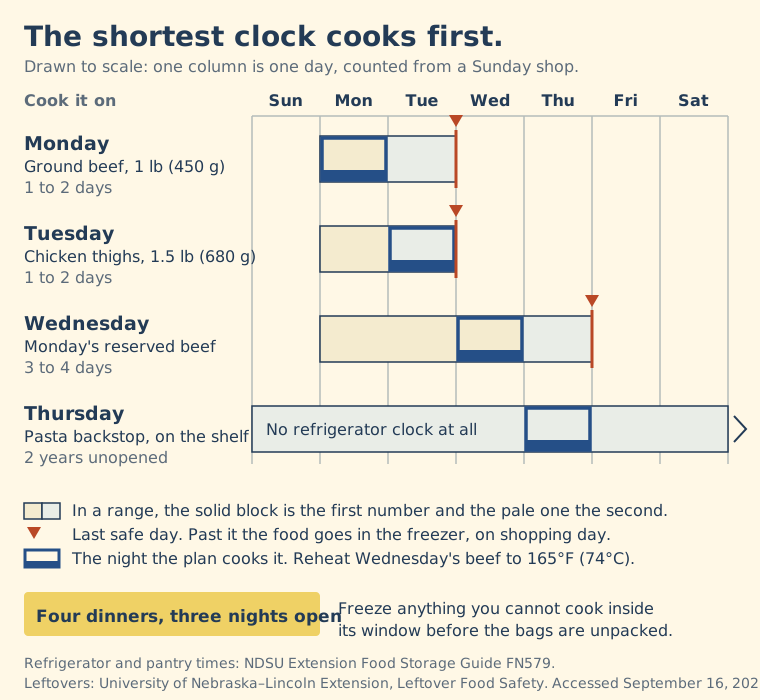
Say you shop on Sunday and buy 1 pound (450 g) of ground beef, 1.5 pounds (680 g) of chicken thighs, a bag of carrots and an onion, alongside the two backstops already on the shelf. The list then writes itself.
- Monday: the ground beef, on day 1 of its 1-to-2-day window. Cook the full pound and set half aside.
- Tuesday: the chicken thighs, on day 2, the last day of their window. Anything you will not cook by Tuesday goes in the freezer Sunday night.
- Wednesday: Monday's reserved beef, day 3 of the 3-to-4-day leftover limit, reheated to 165°F.
- Thursday: the pasta backstop, because Thursday is the night that changes most often and this one needs no shopping.
- Friday and the weekend: unassigned.
Notice what that week never asked for: no spreadsheet, no seven recipes, and no produce bought for a meal three days after it would still have been usable.
Open the refrigerator and name the three things with the shortest clock. Those are Monday, Tuesday and Wednesday. Add one meal you can cook without a recipe, confirm the two backstops are still on the shelf, and stop. Then check the meat you just bought and freeze anything scheduled past its window before the bags are unpacked. That single step, done on Sunday, keeps the rest of the plan honest all week.
Sources and references
- Food Storage Guide (FN579), NDSU ExtensionAccessed 2026-09-16
- Leftover Food Safety, University of Nebraska–Lincoln ExtensionAccessed 2026-09-16
- Make a Plan, University of Illinois Extension (Eat.Move.Save.)Accessed 2026-09-16