
Track each household supply by the rate you use it, not by how the shelf looks when you walk past. The formula is one line: units used per year, divided by twelve, gives units per month; reorder when the stock on hand drops below one month of use plus however long a delivery or a store trip takes. For several common supplies you do not have to estimate the rate at all. A federal agency or a manufacturer has already published the number.
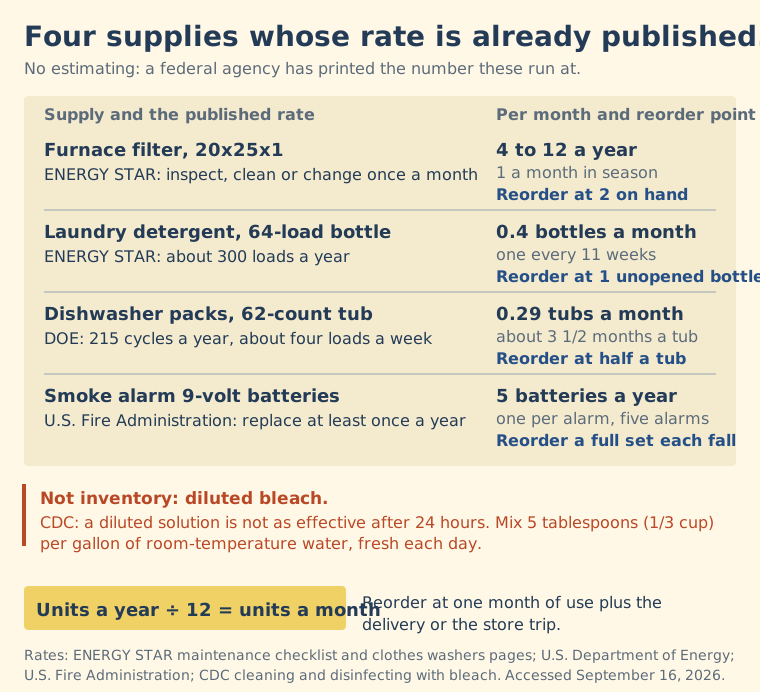
Three you can compute tonight. ENERGY STAR says to inspect, clean or change your furnace, heat pump or central air conditioner filter once a month, which puts a household that replaces on inspection somewhere between four and twelve filters a year. ENERGY STAR reports that the average American family washes about 300 loads of laundry each year, so a detergent bottle marked 64 loads is about 4.7 bottles a year — roughly one every eleven weeks. The Department of Energy uses 215 dishwasher cycles per year, about four loads a week, as its standard residential assumption, so a 62-count tub of dishwasher packs lasts about three and a half months, and you buy roughly three and a half of them a year.
Four columns, and where the rate comes from
Each row needs four columns: the item with its exact product and size, so nobody buys the wrong size after standing in the aisle; the stock location, so nobody buys a second box because the first went unchecked; the rate in units per month, so restocking is not done on vibes; and the reorder point at one month of use plus lead time, so nothing runs out on the day you need it.
Stock location does the most work here. In a household with more than one adult, a shared list without locations produces duplicate purchases; a shared list with them produces a two-second check. If the spare supplies are scattered across four closets, the list inherits that mess, so do a single sweep first — the approach in see what is in the pantry before making a shopping list applies just as well to the linen closet and the garage shelf.
Package counts are the input to every rate on the list, and they are stated inconsistently on purpose. A detergent bottle gives loads. A filter gives one unit. Paper goods give a roll count that may or may not be "double" rolls. Convert everything to the unit you actually consume before you compute a rate, because a 12-pack of double rolls and a 24-pack of regular rolls are the same purchase wearing different numbers. Reading household package sizes consistently is the step that makes two products comparable and makes a monthly rate mean anything.
An example ledger for a four-person household
An example built from the published assumptions rather than any particular home's habits:
- Furnace filter, 20x25x1. Stock location: basement shelf by the furnace. Rate: 1 per month during heating and cooling season, checked monthly per ENERGY STAR. Reorder point: 2 on hand. A 6-pack twice a year covers it.
- Laundry detergent, 64-load bottle. Stock location: laundry room cabinet. Rate: 0.4 bottles per month at the ENERGY STAR figure of about 300 loads a year. Reorder point: 1 unopened bottle.
- Dishwasher packs, 62-count tub. Stock location: under the sink. Rate: 0.29 tubs per month at the DOE assumption of 215 cycles a year. Reorder point: half a tub remaining.
- Smoke alarm 9-volt batteries. Stock location: kitchen junk drawer. Rate: the U.S. Fire Administration says to replace the battery at least once a year, so five alarms means five batteries a year. Reorder point: a full set of five in the drawer each fall.
Adjust a rate the first time reality contradicts it. A household that runs the dishwasher nightly is at 365 cycles rather than 215, which moves the tub from every three and a half months to every two.
What does not belong on the list, and the three rows to start with
Some things look like supplies and are not. Diluted bleach is the clearest case: the CDC says a bleach solution will not be as effective after being mixed with water for over 24 hours, and directs you to make a new diluted solution daily at 5 tablespoons — a third of a cup — per gallon of room-temperature water. The concentrated bottle is inventory. The spray bottle under the sink is not. Empty it rather than tracking it.
The same logic covers anything with a short in-use life: opened food, dated medications, and any product whose label gives a shelf life after opening. Track the sealed package, put the opened one on a use-by note, and keep the two roles apart so the list does not start counting things that have already expired.
Write down the three supplies your household has run out of at the worst moment in the past year. Not the three you think of first — the three you were annoyed about. Give each one a stock location and a rate, using a published assumption where one exists and a count of last year's purchases where it does not. Put the reorder point in writing.
Three rows is a working list. Add a fourth only when a fourth thing runs out, and let the list grow from actual failures rather than from an attempt to anticipate every consumable in the house at once.
Sources and references
- Maintenance Checklist — ENERGY STARAccessed 2026-09-16
- Clothes Washers — ENERGY STARAccessed 2026-09-16
- Purchasing Energy-Efficient Residential Dishwashers — U.S. Department of EnergyAccessed 2026-09-16
- Smoke Alarms — U.S. Fire AdministrationAccessed 2026-09-16
- Cleaning and Disinfecting with Bleach — CDCAccessed 2026-09-16