
Fold the knits. Hang the wovens. The Woolmark Company states the rule without hedging: "Woven wool garments should be hung on shaped or padded coat hangers. Knitted garments should be gently folded and stored in drawers." A knitted sweater on a hanger carries its own weight on two narrow shoulder points and stretches; a woven shirt, jacket or dress does not, and creases instead if you fold it. That one distinction settles most of a wardrobe. What is left is a question of space, and space is measured in inches.
The rule, what overrides it, and the sheet to copy
Look at the fabric, not the garment category. Loops of yarn — a sweater, a T-shirt, a polo, a knit dress, sweatpants — mean knitted, and knitted belongs in a drawer or flat on a shelf. A woven grid of threads — a dress shirt, chinos, a blazer, a woven blouse — belongs on a hanger.
The care label overrides the rule wherever the two disagree. The FTC's Care Labeling Rule requires every garment to carry, at minimum, "a method of washing and a method of drying," attached permanently and legible for the useful life of the product. A label reading "dry flat," defined in the federal glossary as "lay out horizontally for drying," is telling you the garment will not hold its shape under its own weight. So store it flat as well. If the symbols on your tags are unfamiliar, read a clothing care label before sorting and keep the storage decision downstream of it.
Woolmark adds one habit worth copying for any garment you wear often: "Rest wool garments for 24 hours before wearing again." A two-day rotation is a reason to keep two of each staple within reach instead of a stack of eight. For anything going into off-season storage, the same company's storage guidance overrides the hang-the-wovens rule entirely: "Fold, rather than hang. This will help garments retain their shape while in storage," in 100% cotton or wool bags, which "allow the clothes to breathe."
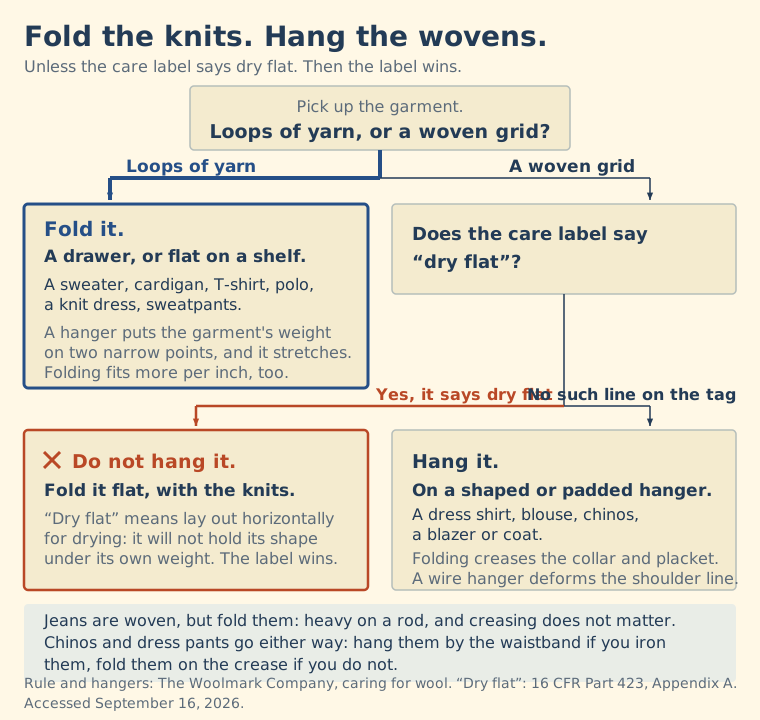
Copy the two rows you argue about. Leave the rest. Trousers are the only genuinely open case, and either answer holds.
Shelf depth decides what you can actually fold
A folding plan fails on inches, not on intent. ClosetMaid's published wire shelving specifications give the numbers to design against:
- Linen shelving comes in 6, 9 and 20 inch depths (15, 23 and 51 cm), plus a 12 inch double-lip version.
- SuperSlide and Linen continuous-slide shelving come in 12 and 16 inch depths (30 and 41 cm).
- Shelf & Rod comes in 12 and 16 inch depths, with your choice of a 10 or 12 inch hang bar location measured from the back wall.
A folded adult sweater is roughly 12 by 14 inches (30 by 36 cm). It fits a 12 or 16 inch shelf and overhangs a 9 inch one, which is exactly why sweaters slide off narrow linen shelving. So fold to your shelf, not to a video. On a 12 inch shelf, fold the sleeves in and halve the body once; on a 16 inch shelf, halve it twice and stack deeper.
Hanging has its own limits. ClosetMaid specifies a 0.75 inch closet rod with a support "one every 36 in. and at each end," and its ShelfTrack installation guide says standards should be "no more than 24 in. apart, and no more than 4 in. from each end." A rod run longer than 36 inches without a mid-support sags under a row of coats. That, not the number of shirts, is the usual reason a closet rod fails.
Worked example: one six-foot closet section
Take a common layout: a 72 inch (183 cm) reach-in closet fitted with a single 12 inch Shelf & Rod unit. That gives one 72 inch rod, which needs a support at the midpoint and one at each end, plus one 12 inch shelf above it.
Wovens go on the rod. At roughly half an inch per slim hanger, 30 shirts and pairs of trousers occupy about 15 inches, so two adults fit on a single rod with room left. Knits go on the 12 inch shelf in stacks no more than five high, so the bottom sweater stays visible and retrievable. Anything that fits neither place — spare jeans, workout knits, pajamas — goes into a dresser drawer instead of being hung "temporarily." Temporary hanging is how a rod ends up over capacity.
If you cannot tell the stacks apart after a week, the problem is naming rather than folding. Choose closet labels that match how you search and put the label on the shelf edge, where you look, instead of on the bin.
Now do the same in your own closet. Empty a single drawer and the rod section above it. Sort into two piles by fabric — loops of yarn versus a woven grid — and ignore everything else about the garments. Knits go back folded to the shelf depth you actually have. Wovens go back on hangers, with a support checked at the midpoint of any rod longer than 36 inches. Anything labeled dry flat joins the knits. Whatever still does not fit is a quantity problem, and resetting a crowded clothes drawer one category at a time is the next move, not buying more hangers. The label wins wherever it disagrees with the rule.
Sources and references
- The Woolmark Company - Caring for WoolAccessed 2026-09-16
- The Woolmark Company - How to store wool clothesAccessed 2026-09-16
- ClosetMaid Wire Shelving Specifications (Rev. 06/12)Accessed 2026-09-16
- ClosetMaid ShelfTrack Installation Tips (01/21)Accessed 2026-09-16
- FTC - Clothes Captioning: Complying with the Care Labeling RuleAccessed 2026-09-16
- 16 CFR Part 423, Appendix A - Glossary of Standard Terms (Care Labeling Rule)Accessed 2026-09-16