
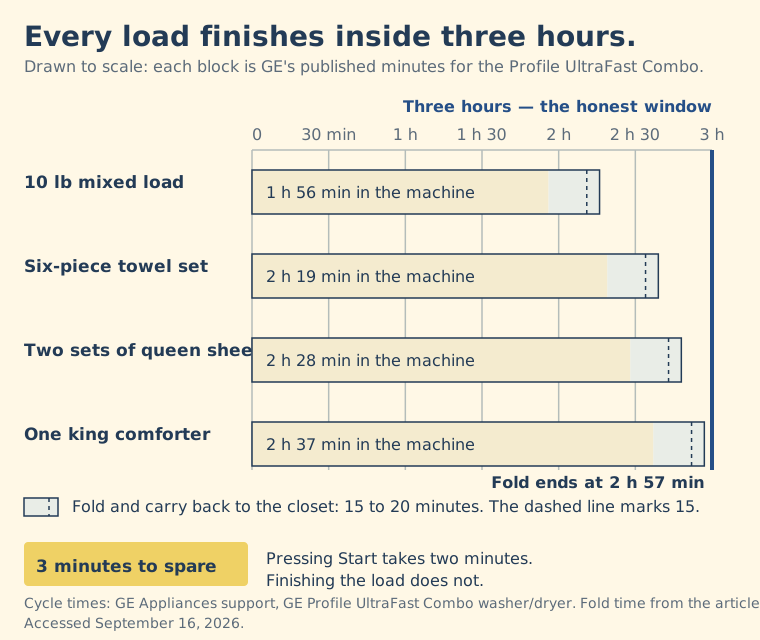
Do not start a load unless three uninterrupted hours sit in front of you. GE's published figures for its Profile UltraFast Combo put a 10-pound mixed load at about 1 hour 56 minutes to wash and dry, a six-piece towel set at about 2 hours 19 minutes, two sets of queen sheets at about 2 hours 28 minutes, and one king comforter at about 2 hours 37 minutes. Add 15 to 20 minutes to fold and carry everything back to the closet, and three hours is the honest window. Build the schedule against that block. Pressing Start takes two minutes; finishing the load does not.
The dryer sets the clock and refuses to be precise
A wash cycle is the predictable half. Drying is not. GE says so in its own support documentation: "There is not a standard dry time unless you use a Timed Dry cycle." The same page lists what moves the number — gas versus electric heat, the size of the load, the fabric, because "cotton fabrics hold more water than synthetic fabrics," how much water the washer's spin already pulled out, whether you chose More Dry or Less Dry, and the condition of the exhaust vent, which "should not be crimped, crushed or restricted in any way."
So a routine built on "the dryer takes an hour" keeps collapsing. Plan against the finished-load figures instead. A separate washer and dryer pair does not run shorter than a combo unit: you add a transfer, and a heavy cotton load on More Dry passes the combo's numbers easily. Knowing which of the two modes your dryer runs settles most of the argument, and the answer sits in the manual — timed drying and sensor drying behave nothing alike on the clock.
Use the load you run most often as your baseline. For most households that is the 10-pound mixed load at roughly two hours of machine time. Towels, sheets and comforters are a two-and-a-half-hour commitment.
How much grace your dryer actually gives you
Every dryer has an anti-wrinkle feature, and they differ by more than two hours in how long they will cover for you.
- Hotpoint Press Guard. The cycle signal sounds one minute before the permanent press or polyester knit cycle ends, then the dryer "will continue to tumble, without heat, for approximately 15 minutes or until the cycle is interrupted." GE Appliances documents this as a feature of some Hotpoint dryers.
- GE Dewrinkle. A standalone rescue cycle providing "approximately 10 minutes of heated tumbling," for the load you came home late to.
- Whirlpool Wrinkle Shield. Adds "30 to 140 minutes of periodic tumbling," with the drum turning back on for 15 to 30 seconds "approximately every 5 to 10 minutes."
Switch on Wrinkle Shield or its equivalent for every load you will not be standing next to. On a Whirlpool at the long setting that is up to 2 hours 20 minutes of usable slack after the heat stops, which covers dinner. On a dryer that offers only Press Guard, your slack is 15 minutes. The chime is a real appointment.
Match the load to the window you have
Scroll sideways to see the full table →
| Free window | What to start | Machine time | Finish move |
|---|---|---|---|
| 3 hours or more | 10 lb mixed load | About 1 h 56 min | Fold at the dryer, put away on the same trip |
| 2 h 45 min or more | Two sets of queen sheets | About 2 h 28 min | Remake the bed straight from the drum |
| 2 h 45 min or more | Six-piece towel set | About 2 h 19 min | Hang on the bar; skip folding entirely |
| Under 1 h 56 min | A quick-wash load only | Not published; time it once on your own machine | Samsung recommends 4 pounds or less on Quick Wash |
| Under 45 minutes | Nothing new | — | Put away the clean basket already waiting |
The last row carries the most weight. A basket of clean laundry sitting in a bedroom is a finished wash and an unfinished chore, and starting a second load on top of it makes the pile worse. If that is the usual pattern in your house, find where the laundry process is getting stuck before touching the schedule at all.
A weeknight that actually ends
Here is the arithmetic for a two-adult household with an ordinary washer and dryer pair, using the GE combo figures as the planning baseline.
- 6:15 p.m. Sort and load the mixed weekday basket: shirts, jeans, kids' clothes. Machine time budgeted at two hours.
- 6:20 p.m. Set the dryer's anti-wrinkle option before leaving the room, so an 8:15 finish does not turn into a 9:30 re-tumble.
- 8:15 p.m. The dryer stops. Wrinkle Shield covers you to roughly 10:35 at the long setting.
- 8:45 p.m. Fold at the dryer. Twenty minutes for a 10-pound load is realistic; folding somewhere else costs you the return trip.
- 9:05 p.m. Everything is in drawers.
Now start at 8:30 p.m. instead. The dryer finishes at 10:30, folding lands at 11:00, and the load goes into a basket. The load did not change. The start time did.
On a weekend, run the bulky items first. Sheets started at 9:00 a.m. finish around 11:30 and free both machines for a mixed load before dinner. The other order pushes the sheets to a point in the evening when nobody wants to remake a bed.
Pick your three-hour blocks now and write them down: one weeknight, one weekend morning, one flexible slot. Assign a load type to each from the table above rather than to whichever hamper looks fullest. When a block collapses, do not substitute a smaller load — put away the clean basket instead, which costs 20 minutes and clears the bottleneck for the next run. If the calendar genuinely holds no three-hour blocks this week, plan for a week with less time at home and commit to one full load that finishes rather than three that do not. Follow your garment label for cycle and temperature. The schedule decides when, not how.
Sources and references
- GE Profile UltraFast Combo Washer/Dryer - Cycle TimesAccessed 2026-09-16
- GE Appliances Support - Dryer: Cycle Dry TimesAccessed 2026-09-16
- GE Appliances Support - Dryer Press GuardAccessed 2026-09-16
- GE Appliances Support - Dewrinkle Cycle (Dryer)Accessed 2026-09-16
- Whirlpool Product Help - Dryer Turns On after Cycle is Complete (Wrinkle Shield)Accessed 2026-09-16
- Samsung US Support - Cycles, settings, and features on your Samsung washing machineAccessed 2026-09-16