
Write six lines and the handoff works: current stage, cycle name, temperature, spin, the exceptions described by appearance, and where the clothes end up. "Can you finish the laundry?" fails because every one of those six is a decision the other person cannot reconstruct from looking at the machine. Six lines takes ninety seconds to write and removes every guess. Put the note where the person will physically stand — taped to the washer lid or the dryer door — rather than in a message they will read in another room and forget on the way downstairs.
The six lines, and the settings they have to name
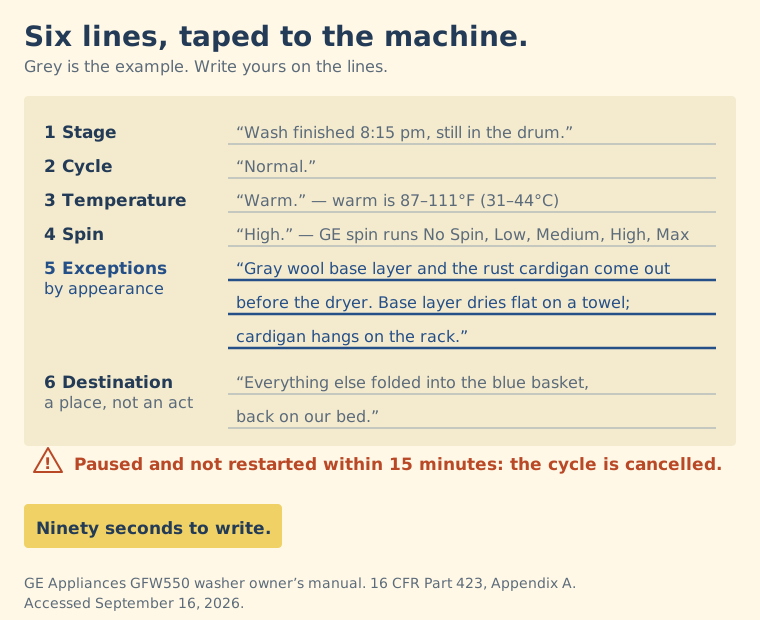
Lines two through four look redundant once the load is washed. They are not. They tell the receiving adult what the machine already did, which is what anyone needs in order to judge whether an extra rinse or a rewash is reasonable, and they are the settings to repeat if a second basket is waiting.
"The usual" is the most expensive phrase in a laundry handoff, because washers do not share vocabulary. On GE's front loaders, the Normal cycle alone offers five water temperatures — Extra Hot, Hot, Warm, Cold and Tap Cold — and three spin speeds. Fifteen combinations behind one dial position. Across the machine, spin runs No Spin, Low, Medium, High and Max, and the manual notes that higher spin shortens dry time but can set wrinkles in some fabrics.
The words themselves are defined, which is what makes them safe to write down. Under the FTC's Care Labeling Rule glossary, warm means an initial water temperature of 87 to 111°F (31 to 44°C) and cold means up to 86°F (30°C). Write "warm" and the other adult, the machine and the garment tag all point at the same range.
Two machine behaviors that quietly break handoffs
The fifteen-minute pause. On GE's front loaders, a paused washer that is not restarted within fifteen minutes cancels the current cycle. So a helpful person who opens the door to toss in one more towel, gets distracted, and comes back twenty minutes later has not paused your load. They have ended it. Put this line in the note whenever the receiving adult has not run the machine before.
The door-lock delay. The same washer can take up to thirty seconds to unlock after Start/Pause is pressed. People who do not know that pull the handle, decide the machine is broken, and walk away. One sentence prevents it: "door takes 30 seconds to unlock, do not force it."
The dryer equivalent is Damp Alert, which beeps when the load reaches a damp level so hang-dry pieces can come out while the rest keeps running. When the exceptions are tumble-dry-low items rather than line-dry items, asking the other person to press that pad beats asking them to guess at timing.
Exceptions by appearance, and a finish that names a place
Owner names fail in shared laundry and category names fail across people. "Dan's stuff" and "the delicates" both assume knowledge the receiving adult may not have. Appearance assumes nothing: color, fabric, one distinguishing detail. "The rust-colored sweater with the ribbed cuffs" is findable by anyone, including a teenager who has never run this load.
Attach the instruction to the description on the same line, in the label's own words. Dry flat and line dry are different physical actions — the glossary defines line dry as hanging damp from a line or bar, and dry flat as laying the item out horizontally — so naming which one applies is not fussiness. The garment label wins over any household habit here.
When the same exception recurs weekly, photograph its tag once and keep the picture in a shared album. Three photographed tags cover most households, and the reading behind them is the same reading that lets you sort any mixed basket by compatible care in the first place.
Two things end a handoff cleanly: a time and a defined finish. "Before bed" or "by 7 pm tomorrow" is a time. A defined finish is almost always a location rather than an action — "folded" is ambiguous, "folded and in the top drawer" is not.
Then take the note down when the load is done. A washer wearing three weeks of sticky notes trains everyone in the house to ignore all of them, today's included.
Handing off mid-cycle without losing the drying decision
The hardest handoff is the one in the middle of a load, because the drying exceptions are sealed inside the washer where nobody can see them. Solve it before you leave. Either pull the exception items out at the end of the wash yourself, or write them on line five before you start rather than after. The habit that makes this automatic is keeping the wash decision and the dry decision as two separate records from the beginning. And when the same handoff fails at the same point every week — clothes reach the dryer but never the drawer — that is a routine problem, not a note problem, and it is worth agreeing explicitly on where one person's job ends.
Sources and references
- GE Appliances Washers GFW850/GFW650/GFW550/GFW510/HFW350 Owner's Manual (49-3000217 Rev 5)Accessed 2026-09-16
- 16 CFR Part 423 (Care Labeling Rule), Appendix A: Glossary of Standard TermsAccessed 2026-09-16
- GE Appliances GFD55 Dryer Owner's Manual (49-3000415 Rev 1)Accessed 2026-09-16