
Write every shared chore as four fields: the trigger that starts it, the scope it covers, the finish state another person can check, and one named owner. Then set a rebalancing date 90 days out. "Do the kitchen" is not an agreement. "When the last person leaves the dinner table, Sam runs the dishwasher, wipes the counters and leaves an empty sink; Sam owns this through December 15" is. Use the four-field form for every recurring chore, and rotate the owner only when two people genuinely have interchangeable schedules.
Four fields sound bureaucratic until you notice what the three standard arguments are about: when it should have happened, how much of it counted, and whether it was finished. All three are missing information. Filling in the fields removes the ambiguity the argument was built on.
What has to go in each of the four fields
- Trigger: an observable event, not a time of day. "After dinner" beats "in the evening," because anyone can check the dishwasher against it. Triggers tied to an event with a fixed cadence — trash pickup, a grocery delivery, the school run — hold up better than triggers tied to a clock.
- Scope: the boundary, written as an exclusion. "Counters and sink; the stovetop is a separate Saturday task." Most scope disputes are about the edge case. Write the edge case down the first time it comes up.
- Finish state: what a person walking into the room would see. "Empty sink, dry counters, dishwasher running or emptied." A finish state that needs an explanation is still too vague.
- Owner: one adult's name. Two names mean nobody. If the work truly needs two people, write two agreements with two triggers: one person clears and loads after dinner, the other unloads before breakfast.
Then add a fifth line that is not a field but a date: the day you will look at the whole set again. Ninety days is long enough that nobody re-litigates the split every week, and short enough that a bad split does not quietly become permanent.
The two hours a day you are actually dividing
Americans spent an average of 1 hour 59 minutes a day on household activities in 2025, according to the Bureau of Labor Statistics American Time Use Survey. That total breaks down into food preparation and cleanup (43 minutes), housework such as cleaning and laundry (34 minutes), lawn and garden care (11 minutes), and household management such as bills and scheduling (10 minutes).
The split between adults is not even. Women averaged 2 hours 23 minutes a day and men 1 hour 35 minutes, a gap of 48 minutes every day, or about 5.6 hours a week. On an average day, 87% of women and 75% of men did some household activity at all.
Use those figures as a scale. If your list assigns one person 90 minutes of daily work and the other 30, you have reproduced the national gap inside your own kitchen. Total the minutes on each side first. Nobody agrees before that.
Four chores, written twice
Scroll sideways to see the full table →
| Chore as usually stated | Trigger | Finish state | Typical minutes per day |
|---|---|---|---|
| "Deal with laundry" | Hall hamper is full | Clean load folded and in drawers, machine empty | 15 to 20 |
| "Do the kitchen" | Last person leaves the dinner table | Empty sink, dry counters, dishwasher running | 20 to 25 |
| "Handle the mail" | Mail arrives | Recycling gone, anything needing action in the one tray | 3 to 5 |
| "Keep the yard up" | Saturday morning | Grass cut, clippings bagged, mower back in the shed | 11, averaged across the week |
The right-hand column matters more than it looks. "Handle the mail" and "do the kitchen" sit as equal-looking lines on a shared list. One is a five-minute job; the other is five times larger. Size the items before you divide them. If you do not have that inventory yet, start with a household task list you can revise.
Split whole tasks, not steps inside a task
Give one person the entire laundry chain, from sorting to putting away, rather than giving one person the washing and another the folding. Split chains create a handoff. The handoff is where the work stalls and where the resentment collects. When a chain genuinely must be shared, write the handoff as its own agreement with its own trigger and finish state, the way you would for a laundry handoff to another adult.
Perception is the second reason to be specific. In a Pew Research Center survey of 2,242 US working parents conducted March 2 to 15, 2026, 43% of respondents in couples where both parents work full time said the mother does more of the household chores, 17% said the father does more, and 40% said the work was shared about equally. Among mothers alone, 63% said they personally handle more. Two adults in the same house describe the same week differently, and a written finish state is what settles who did what.
The stakes are ordinary and measurable. In Pew survey data, 56% of married US adults called sharing household chores very important to a successful marriage, ahead of having children (43%) and adequate income (42%). In the 2026 working-parents survey, 54% of working mothers were satisfied with the division of chores when the work was shared about equally, against 11% when they did more.
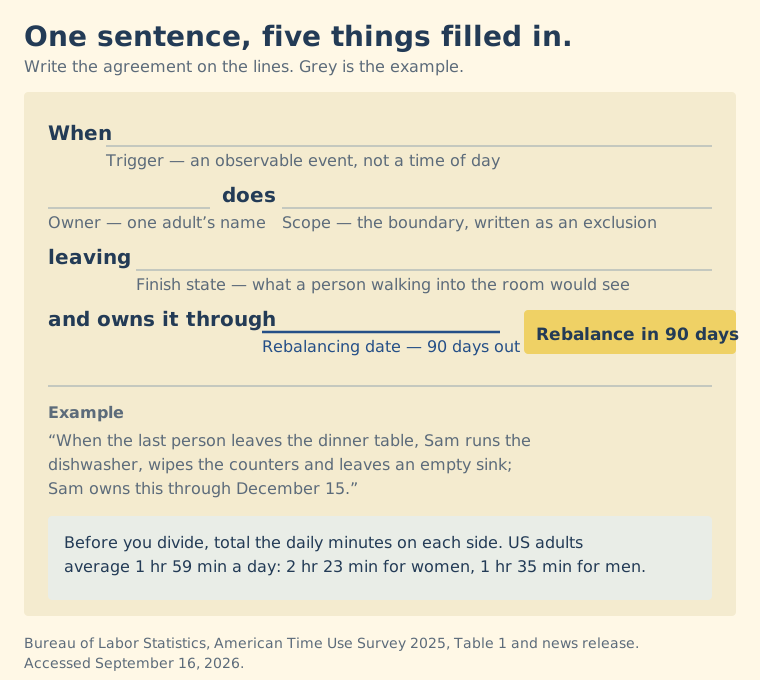
Pick the three chores that caused friction in the past two weeks. For each, fill in trigger, scope, finish state and owner in a single sentence, then read it aloud to the other person. If they can restate the finish state back to you without asking a question, it is concrete enough. Put the 90-day date in a shared calendar and paste the three sentences into the event body, so the review starts from the original wording rather than from memory. At that review, add up the daily minutes on each side before you change anything, and if one column runs more than roughly 30 minutes a day heavier, move a whole chore rather than a step. One agreement keeps failing even after it is written down? Then the wording is not the problem and the design is: review the routine itself.
Sources and references
- American Time Use Survey, Table 1: Time spent in primary activities (2025 annual averages)Accessed 2026-09-16
- How working parents divide family responsibilitiesAccessed 2026-09-16
- Sharing chores a key to good marriage, say most married adultsAccessed 2026-09-16
- American Time Use Survey news release, 2025 resultsAccessed 2026-09-16