
Give the house sitter one page with nine items, in this order: the main water shutoff, the breaker panel, the gas shutoff and the gas company's phone number, the smoke alarm situation, the thermostat setting, the pet feeding amount copied word for word off the food label, trash and recycling day, the mail plan, and two phone numbers — yours and a local person who has a key. Everything else goes in a folder the sitter opens only if they need it. Four safety items go on every note. Even a two-night stay gets all four. Expand the page only when an unfamiliar sitter is staying more than about a week.
The four safety lines belong at the top
Ready.gov's household safety guidance says to find the main water shutoff valve, tag it so everyone in the household knows where it is, and check that it still turns. That is a valve you can use, not the street valve at the meter, which needs a utility tool. Write the room and the motion: "basement, on the wall behind the water heater; lever valve, one quarter turn until the handle sits crosswise to the pipe."
Plumbing failures are not rare, which is why that line goes first. EPA WaterSense estimates the average household's leaks waste more than 9,300 gallons of water a year, and that 9% of US homes have leaks wasting 50 gallons or more per day. A sitter watching water spread across a floor at 11 p.m. needs one sentence, not a search.
For the breaker panel, give the location and say whether the circuits are labeled. Ready.gov's instruction there is to shut off the individual circuits before shutting off the main. For gas, write the utility's number and one instruction: if you smell gas, leave the house and call from outside. Ready.gov is explicit that nobody should attempt to turn the gas back on themselves. Skip the relighting procedure. Give the phone number instead.
The fourth line is the smoke alarms. The US Fire Administration recommends testing smoke alarms monthly, replacing 9-volt batteries at least once a year, and replacing every alarm 10 years after its manufacture date. Alarms belong inside and outside each sleeping area and on every level of the home, ideally interconnected so one triggers all.
Test the alarms the day before you leave and write that date on the note. Then add the line that prevents the classic 3 a.m. problem: NFPA notes that a single chirp every 30 or 60 seconds means a low battery, spare 9-volt batteries are in the drawer you name, and the alarm should not be removed or disconnected. An alarm approaching 10 years old gets replaced before you travel, not left as somebody else's decision.
Numbers, not adjectives, for pets and daily tasks
Copy pet feeding amounts straight off the package. AAFCO's guidance on reading pet food labels is that feeding directions state how much food to give per weight of the animal per unit of time for the animal's life stage, so the exact figure a sitter needs is already printed on the bag. Name the measuring implement too. "A scoop" is not a unit. FDA notes that a "complete and balanced" nutritional adequacy statement means the product is intended as the pet's sole diet, so the note should also say what not to substitute if the bin runs low.
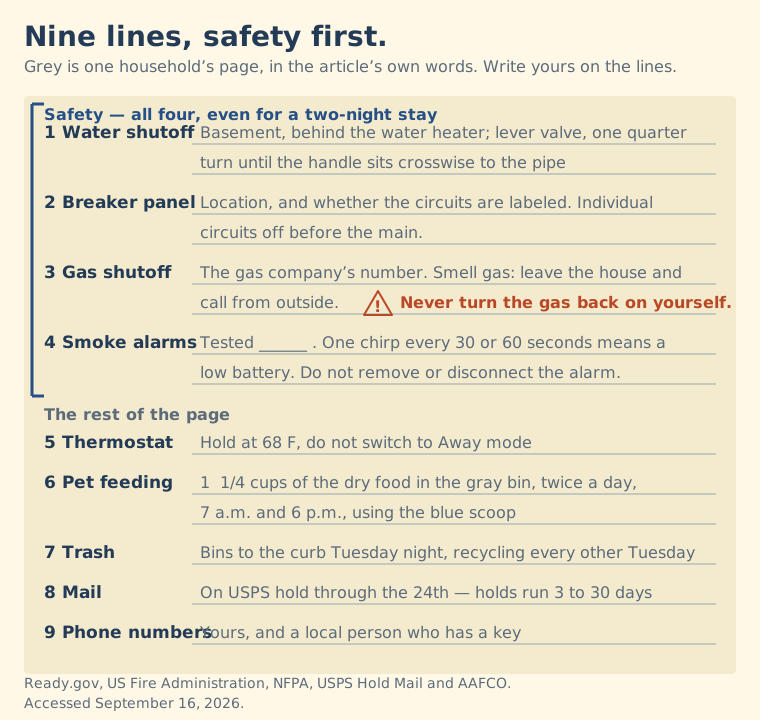
Written out, those lines read “1 1/4 cups of the dry food in the gray bin, twice a day, 7 a.m. and 6 p.m., using the blue scoop” off the feeding directions panel on the bag, “Half a 5 mg tablet each morning, bottle on the second shelf” off the prescription label, “Hold at 68 F, do not switch to Away mode” from your own setting, “Bins to the curb Tuesday night, recycling every other Tuesday” from the city collection calendar, and “On USPS hold through the 24th, nothing to collect” from your hold confirmation.
Every line is checkable by someone who has never been in the house. That is the only test the page has to pass.
What belongs somewhere other than the page
USPS Hold Mail pauses delivery for a minimum of 3 days and a maximum of 30 days, can be scheduled up to 30 days in advance, and must be requested by 3 a.m. Eastern on your chosen start date. For an absence longer than 30 days, USPS points you to forwarding instead. A hold removes a job from the sitter's list and keeps a stuffed mailbox from advertising an empty house. Note the end date so the sitter is not waiting for mail that will not come.
Appliance questions work the same way. Rather than explaining the washer in prose, point at the manuals: if you keep a household reference folder, one line saying where it lives replaces half a page. If the sitter will run laundry, write that as its own short handoff with a stated finishing point, the way you would hand laundry to another adult.
Alarm codes, the main Wi-Fi password and the location of spare keys go to the sitter in a separate message or in person. Not on a sheet visible to anyone who walks into the kitchen. Put the alarm company's number on the page instead, so a false alarm gets resolved without the code being written down anywhere. Requests that came up in conversation but were never agreed to, such as watering the garden, belong where household actions already live: one place for household actions.
The ten-minute walkthrough that catches the rest
Walk the sitter through the house with the page in hand and physically touch four things: the water valve, the breaker panel, the thermostat, and the bin where the pet food lives. Ask them to read the feeding line back while standing in front of the bag. That catches a wrong scoop or a misread number on the spot. Then text them the page so it is on their phone when the printed copy is in another room. Confirm both numbers work before you leave.
Sources and references
- Ready.gov: Safety Skills, shutting off utilitiesAccessed 2026-09-16
- US Fire Administration: Smoke alarmsAccessed 2026-09-16
- USPS Hold Mail serviceAccessed 2026-09-16
- EPA WaterSense: Fix a Leak WeekAccessed 2026-09-16
- AAFCO: Reading pet food labelsAccessed 2026-09-16
- FDA: \u201cComplete and Balanced\u201d Pet FoodAccessed 2026-09-16
- NFPA: Learn the Sounds of Fire Safety (smoke and CO alarm sounds)Accessed 2026-09-16