
A cleaning card has five fields. The one households leave off is the number that decides whether the job worked: contact time. Clorox Disinfecting Wipes direct you to use enough wipes that the treated surface stays visibly wet for 4 minutes to disinfect. The same label gives a separate 10-second wet time for sanitizing. A swipe that dries in twelve seconds did the sanitizing job, not the other one. The card carries that 4 into the moment somebody is standing at the counter with the canister in hand.
Decide first whether the card should say disinfect at all. CDC guidance is that cleaning alone removes most harmful viruses and bacteria from surfaces, and that disinfecting belongs to two situations: someone in the house is sick, or someone is at higher risk because of a weakened immune system. Default every routine card to clean. Switch a card to disinfect while illness is in the house, and switch it back when it leaves.
Five fields, and the dwell times copied straight off the label
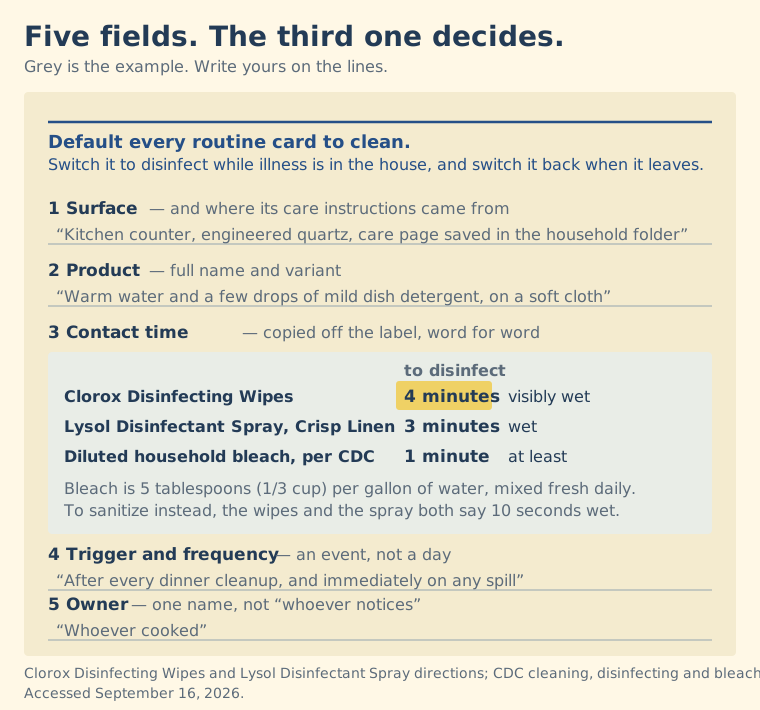
A trigger is an event rather than a day — "after raw chicken" beats "weekly" on a cutting board, and "Sunday, and after guests" suits the high-touch surfaces the CDC names: light switches, doorknobs and countertops — and the product goes down by full name and variant, because Lysol Disinfectant Spray and Lysol Disinfecting Wipes are different labels with different numbers.
These are the directions as the labels and the CDC state them. Copy the numbers, do not paraphrase them.
Scroll sideways to see the full table →
| Product | To sanitize | To disinfect | How the directions say to apply it |
|---|---|---|---|
| Clorox Disinfecting Wipes | Keep surface wet 10 seconds | Surface visibly wet 4 minutes | Use enough wipes to hold that wet time, pre-clean visibly soiled areas, then let air dry |
| Lysol Disinfectant Spray, Crisp Linen | Wet 10 seconds | Wet 3 minutes | Hold can upright 6 to 8 inches away and spray 3 to 4 seconds until covered with mist, then air dry |
| Diluted household bleach, per CDC | — | At least 1 minute | 5 tablespoons (1/3 cup) bleach per gallon of room-temperature water; mix a fresh batch daily |
Two notes belong on the bleach card. The CDC says a bleach solution will not be as effective after it has been mixed with water for over 24 hours, so a jug mixed last week is water, not a supply. And the ratio assumes regular unscented household bleach at 5 to 9 percent sodium hypochlorite, which is printed on the bottle.
What the surface's own care page vetoes
The product label tells you how long. The care page tells you whether that product may touch this surface at all, and the two disagree more often than you would expect. Settle that once, before any card gets written: matching a surface to its manufacturer's care page is a separate twenty minutes and it saves the cards from being wrong.
DuPont's Corian use-and-care guidance allows warm soapy water, an ammonia-based household cleaner, or a dedicated countertop cleaner for routine cleaning, and warns off window cleaners because they leave a waxy build-up that dulls the surface.
Caesarstone's care page for its quartz, mineral and fusion surfaces takes a different shape: warm water with a mild detergent, rinse, dry with a soft cloth, then a named list of products to keep off the stone, including oven and grill cleaners, floor strippers, toilet bowl cleaners, oil soaps and furniture cleaners, drain products, and cleaners sold for granite or marble. The page calls the surface nonporous and virtually maintenance-free. In practice that means there is no sealing task — one some households still carry on their list for no reason.
Both pages say to put hot cookware on a trivet rather than on the counter. Put that line on the card. It is the instruction a guest is most likely to break.
A filled-in card, as an example
For a household with an engineered quartz kitchen counter and nobody currently sick, the card reads:
- Surface: Kitchen counter, engineered quartz, care page saved in the household folder
- Product: Warm water and a few drops of mild dish detergent, on a soft cloth
- Contact time: None required; wipe, rinse, dry
- Trigger and frequency: After every dinner cleanup, and immediately on any spill
- Owner: Whoever cooked
- Do not use: Oven cleaner, drain product, granite or marble cleaner, undiluted bleach
- If someone is sick: Add a second card using Lysol Disinfectant Spray, 6 to 8 inches, 3 to 4 second spray, wet for 3 minutes, on the doorknobs and light switches rather than on the food-preparation surface
That last line does real work. Clorox's disinfecting directions cover hard, nonporous, non-food-contact surfaces, so a counter where you cut vegetables is better served by hot soapy water than by stretching a wipe's directions to fit. Soap wins on the cutting board.
Write each card on an index card and tape it inside the cabinet door above the cleaning supplies. Not in a binder in another room. Three cards make a starting set: kitchen counter, bathroom, and high-touch surfaces during illness. Keep the manufacturer care pages themselves in a household reference folder and let the cards stay the short version. When you buy a different cleaner, check its directions against the card before the old bottle runs out, because dwell time is a property of the product rather than of the surface, and it changes with the bottle.
Sources and references
- Clorox Disinfecting Wipes — directions for useAccessed 2026-09-16
- Lysol Disinfectant Spray, Crisp Linen 12.5 oz — directions for useAccessed 2026-09-16
- When and How to Clean and Disinfect Your Home — CDCAccessed 2026-09-16
- Cleaning and Disinfecting with Bleach — CDCAccessed 2026-09-16
- Use & Care — Corian Solid SurfaceAccessed 2026-09-16
- Care and Maintenance for Fusion, Mineral and Quartz Surfaces — Caesarstone USAccessed 2026-09-16