
Build the folder with five tabs and one retention rule: Appliances, Home, Money, Health, and People. Keep tax paperwork for three years, the general period the IRS sets, and let four documented exceptions stretch that to four, six, seven, or forever. Everything else in the folder is reference you keep as long as you own the thing it describes. A 13-pocket expanding file is enough. The habit that carries the whole system is naming every appliance document by its model number rather than by what the appliance is called at home.
Five tabs that cover a household
Appliances holds the use-and-care manual, the model number, the purchase date, and the warranty card for anything with a plug or a water line. Home holds the deed or lease, the paint colors, the filter sizes, and the contractor invoices. Money holds tax returns, receipts that support a deduction, and closing statements. Health holds immunization records, medication lists, and a printed copy of each insurance card. People holds the copies of identity documents you need to reference, with the originals kept elsewhere.
Those five are not arbitrary. Ready.gov's financial preparedness guidance names the same clusters when it lists what a household should be able to put its hands on quickly: photo ID, birth certificates, Social Security cards, and military service records; housing payment records, insurance policies, and income and tax statements; physician contacts, health insurance copies, immunization records, and medication lists; plus a contact list for banks, insurance agents, and service providers.
Five is enough structure to leave no miscellaneous pile. It is also few enough to hold in your head while standing at the counter with a stack of mail.
How long to keep the Money tab
The IRS ties retention to the period of limitations, the window in which you can amend a return or the agency can assess more tax. Its published periods are specific enough to act on:
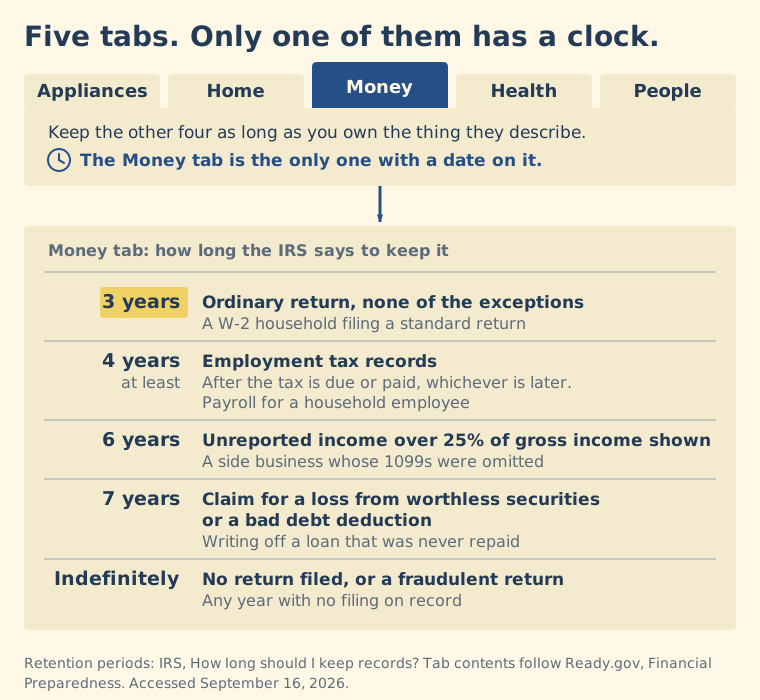
A claim for credit or refund filed after the return — an amended return for a missed deduction, say — runs 3 years from filing or 2 years from paying the tax, whichever is later.
Default to three years. Expand only when one of those situations is yours. Records relating to property are their own case: the IRS says to keep them until the period of limitations expires for the year you dispose of the property, because that is what establishes your basis. In practice a home improvement receipt from 2012 stays in the folder until three years after you sell the house.
Name every appliance file by its model number
A reference folder fails six months later, at the moment you cannot tell which manual goes with which machine. File by the identifier the manufacturer uses, not by the nickname.
Bosch shows the pattern clearly. Its owner manuals and spec sheets search takes a Model Number, printed as E-Nr on the appliance's rating label, and the site includes an interactive guide showing where the rating plate sits for each appliance category. On a phone, a camera icon in the search field reads the plate and fills the number in for you. Other manufacturers use different names for the same thing, and the pattern holds: one string on a sticker resolves to exactly one document.
So write that string on the front of the paper manual in marker, and use it as the filename for the PDF. Bosch's own use and care manual for the SHP78CM5N dishwasher is published as a numbered document, so SHP78CM5N-dishwasher-use-and-care.pdf beats manual-final.pdf by a wide margin. Record the URL you downloaded it from on the same line of your index, because manufacturer sites reorganize and a saved file outlasts a saved link. Getting the right document in the first place is its own small task, covered in find the manual that matches your appliance.
What does not belong in the folder
Three things stay out. Originals of birth certificates, passports, and Social Security cards belong in a fire-resistant box or a safe deposit box; Ready.gov points to a safe deposit box, an external drive, or the cloud for exactly this material. Passwords and account numbers belong in a password manager, not in a folder that sits in a kitchen cabinet. And anything that still needs a decision is not reference at all. It is a task: "call about the warranty" belongs on your action list, and one place for household actions is where that split gets made.
Incoming mail is the other pressure on this system. Let the folder become the place paper lands rather than the place paper ends up, and it fills with unsorted envelopes within a month; keeping household paperwork out of the kitchen covers the arrival route that prevents it.
Set aside ninety minutes. Label five tabs and put them in the expanding file. Walk the house with your phone and photograph the rating plate on the dishwasher, washer, dryer, refrigerator, range, water heater, and furnace, renaming each photo with the model number as you go. Back at the table, sort the paper you already have into the five tabs and put anything you cannot place into a sixth stack. Work that stack to zero before you stop, because it is the stack that otherwise becomes the folder's real contents. Last, write the date on the inside cover and set a calendar note for the same date next year to pull anything from the Money tab that has passed its three-year mark.
Sources and references
- How long should I keep records? - Internal Revenue ServiceAccessed 2026-09-16
- Financial Preparedness - Ready.govAccessed 2026-09-16
- Search for Owner Manuals and Spec Sheets - BoschAccessed 2026-09-16
- SHP78CM5N Use and Care Manual, en-usAccessed 2026-09-16