
Keep two sets of sheets per bed — one on the mattress, one on the shelf nearest that bed — and label every shelf by mattress size rather than by room. That is the system. It works because the alternative fails predictably: one central linen closet holding four sizes of folded white sheets is unsearchable, since a twin fitted sheet at 39 by 75 inches (99 by 191 cm) and a twin XL at 39 by 80 inches (99 by 203 cm) are indistinguishable once folded. Store linens where they are used, in the size they fit, and the search problem goes away.
Why two sets per bed is the right number
Two sets lets you strip a bed and remake it immediately, then wash at your convenience. Three sets means one set never comes into rotation while taking shelf depth from something that would. One set means the bed stays bare until the wash finishes. That is not a short wait: GE publishes about 2 hours 28 minutes to wash and dry two sets of queen sheets, longer than a 10-pound mixed load at about 1 hour 56 minutes, because sheets are bulky and slow to dry.
The exception is a child's bed, or a guest bed used by someone who may need a change in the middle of the night. Keep three sets there, two everywhere else.
Every mattress size, and the sheet that fits it
US mattress sizes are standardized, and the sheet that fits one is not interchangeable with its neighbor.
Scroll sideways to see the full table →
| Size | Mattress | Fitted sheet | Pillowcase |
|---|---|---|---|
| Twin | 38 x 75 in (97 x 191 cm) | 39 x 75 in | 20 x 26 in |
| Twin XL | 38 x 80 in (97 x 203 cm) | 39 x 80 in | 20 x 26 in |
| Full | 53 x 75 in (135 x 191 cm) | 54 x 75 in | 20 x 26 in |
| Queen | 60 x 80 in (152 x 203 cm) | 60 x 80 in | 20 x 26 in |
| King | 76 x 80 in (193 x 203 cm) | 76 x 80 in | 20 x 36 in |
| California King | 72 x 84 in (183 x 213 cm) | 72 x 84 in | 20 x 36 in |
The differences you cannot see in a folded stack
Two traps live in that table. Twin and twin XL differ by five inches of length and nothing else, so a mislabeled set simply will not stay on the mattress. And a standard pillowcase at 20 by 26 inches against a king at 20 by 36 inches is a ten-inch difference that is invisible in a folded stack, which is how a household that owns both ends up with one pillow permanently half covered.
Check pocket depth too. Standard fitted sheets fit mattresses up to about 12 inches deep, and deep-pocket styles go to about 18 inches, so a sheet that fit your old mattress may not fit a new one of the same nominal size.
Write the size on a sewn-in tag or in fabric marker on the hem, not only on the shelf. Then label the shelf with size plus destination: "Queen, front bedroom," not "sheets."
Shelf depth decides what can live where
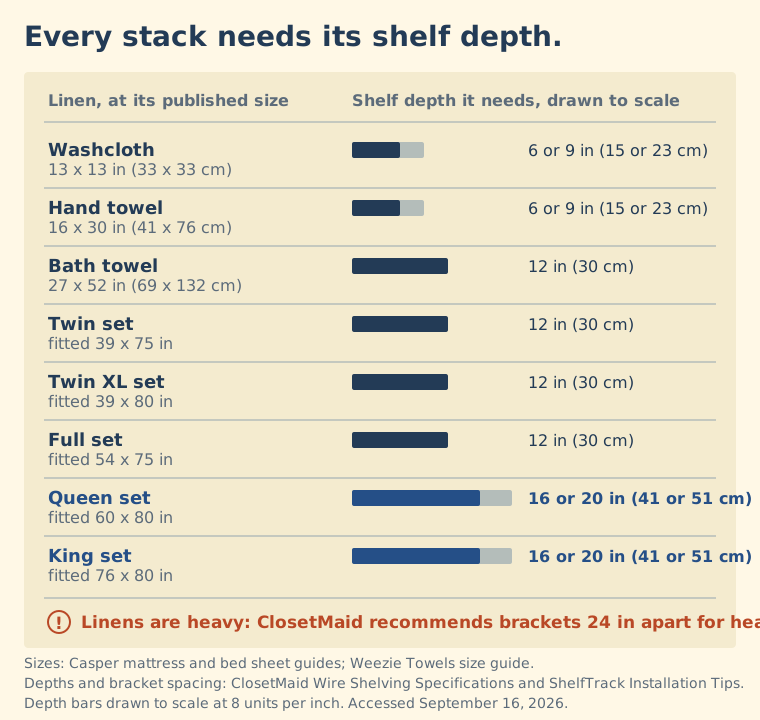
ClosetMaid's published wire shelving specifications give the depths to plan against. Linen shelving comes in 6, 9 and 20 inch depths (15, 23 and 51 cm) plus a 12 inch double-lip version, and SuperSlide and Linen continuous-slide shelving come in 12 and 16 inch depths (30 and 41 cm).
Match the item to the depth, not the other way around:
- 6 and 9 inch shelves hold washcloths (13 x 13 in / 33 x 33 cm) and hand towels (16 x 30 in / 41 x 76 cm) folded in thirds. A folded queen sheet set overhangs them.
- 12 inch shelves hold folded bath towels (27 x 52 in / 69 x 132 cm) and a folded twin, twin XL or full set.
- 16 and 20 inch shelves are what queen and king sets need, and what a folded duvet cover needs.
Linens are heavy. Respect the span limits. ClosetMaid specifies support brackets for a 36 inch span, with 24 inches recommended "for areas designed for heavy use," and its ShelfTrack guide says standards "should be spaced no more than 24 in. apart, and no more than 4 in. from the end of the shelf." A sagging linen shelf is a bracket-spacing problem rather than a weight problem, and adding a mid-bracket is cheaper than moving the linens. The same reasoning applies whenever a shelf is deeper than you can see into — organize one deep cabinet without losing the back row covers the retrieval side of it.
Towels belong to the bathroom, not the linen closet
Apply the same destination rule to towels, with one difference: the unit is the person, not the bed. Give each person one bath towel, one hand towel and one washcloth in use, and keep a single spare set per bathroom on the nearest shelf. Nearest, not central.
A standard bath towel is 27 by 52 inches. A beach towel at 30 by 60 inches and a kitchen towel at 19 by 17 inches are different categories that should not share that shelf. Those are the pieces people pull by mistake, because the size difference is small and the stack is uniform. Spare bath linens kept in the bathroom rather than in a hall closet remove the most common reason a wet person has to call down the hallway.
Start with the shelf nearest your own bed. Take everything off it, measure one fitted sheet corner to corner if you are unsure of its size, and keep exactly two complete sets for that bed: fitted, flat, and the matching pillowcases. Everything else goes to another bed's shelf, to the towel shelf, or out of the house. Label the shelf edge with size plus room. Then stop. Repeat for one more bed next weekend rather than emptying the entire closet at once. If the labels still do not match how people actually search, choose closet labels that match how you search. If the folded stacks keep collapsing over the shelf edge, the fold is wider than the shelf, and the fold-or-hang decision sheet covers matching a fold to the depth you have.
Sources and references
- Casper - Mattress Sizes and Bed Dimensions GuideAccessed 2026-09-16
- Casper - Bed Sheet Sizes & Dimensions GuideAccessed 2026-09-16
- Weezie Towels - Towel Sizes: A Complete GuideAccessed 2026-09-16
- ClosetMaid Wire Shelving Specifications (Rev. 06/12)Accessed 2026-09-16
- ClosetMaid ShelfTrack Installation Tips (01/21)Accessed 2026-09-16
- GE Profile UltraFast Combo Washer/Dryer - Cycle TimesAccessed 2026-09-16