
Multiply the stated capacity by about 1.5 for a tall canister and by about 2.2 for a shallow rectangular food container, and you have the shelf volume the thing will eat. An OXO POP Big Square Medium holds 4.4 quarts (17.6 cups) and occupies a 6.1 x 6.1 x 10 in (15.5 x 15.5 x 25.4 cm) box, which is 6.4 quarts of shelf. Capacity tells you how much food goes in. Only the outside dimensions tell you whether the cabinet door closes.
So shop by height first, footprint second. The number on the front of the box is a food-portion figure, not a storage figure.
Where the missing volume goes
A stated capacity is the interior, measured to the rim. Everything else is structure: wall thickness, a lid that clips over the rim rather than sitting inside it, a lip or gasket channel, and on pantry canisters a push-button mechanism that adds real height. On a shallow rectangular container the walls and lid are a large fraction of a small box, so the penalty is severe. On a tall canister the same wall thickness spreads over more volume. The penalty is milder.
That is why two containers with identical stated capacity need different shelves. It is also why four small containers eat far more cabinet than one canister of the same total capacity.
Four containers against their own published numbers
Every figure below is the manufacturer's or retailer's published spec, with the external box volume calculated from those same dimensions.
Scroll sideways to see the full table →
| Container | Stated capacity | Outside dimensions | Shelf volume it occupies | Overhead |
|---|---|---|---|---|
| IKEA 365+ with lid, plastic (395.670.68) | 34 oz (4.25 cups) | 8 1/4 x 6 x 2 3/4 in (21 x 15 x 7 cm) | 2.4 qt | 2.2x |
| IKEA 365+ with lid, glass/plastic (895.670.61) | 34 oz (4.25 cups) | 8 x 6 x 3 in (20 x 15 x 7.6 cm) | 2.5 qt | 2.35x |
| OXO POP Rectangle Tall | 3.7 qt (14.8 cups) | 6.3 x 4.1 x 13.1 in (16 x 10.4 x 33.3 cm) | 5.9 qt | 1.6x |
| OXO POP Big Square Medium | 4.4 qt (17.6 cups) | 6.1 x 6.1 x 10 in (15.5 x 15.5 x 25.4 cm) | 6.4 qt | 1.46x |
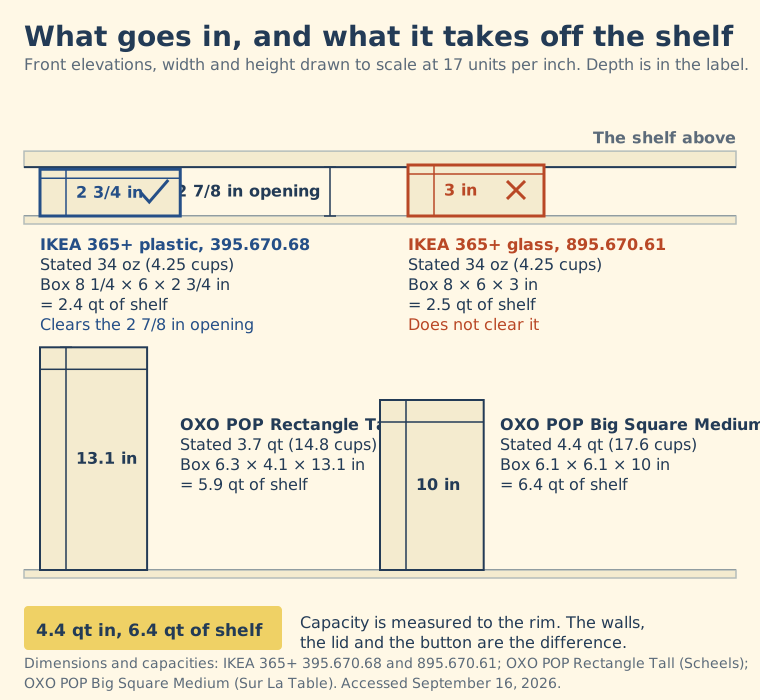
Two things fall out of that table. The two IKEA 365+ containers carry the same 34 oz rating and are not interchangeable in a tight space: the glass version is 3 in tall where the plastic one is 2 3/4 in, and the plastic one runs a quarter inch longer. On a shelf with 2 7/8 in of clearance, one goes in and the other does not. And the shallow containers waste more than twice their own capacity in shelf volume, while the tall canisters waste roughly half.
Measure the height of the opening, not the shelf
Height is what fails. Measure from the shelf surface to the underside of whatever is above it, then measure again at the front edge, because a face frame, a hinge or a lip at the cabinet opening often sits lower than the shelf interior. Use the smaller number.
Then subtract for how the container comes out. Lift it straight up and out, and you need roughly 1/2 in of free space above the lid to clear. Slide it out flat, and you need none, but you do need a clearance path with nothing overhanging the front. On that allowance a 10 in canister needs about 10 1/2 in of opening.
Check the lid the same way. A push-button POP lid opens in place on the counter, so its height is fixed. A clip-lid food container has to be laid down and unclipped, so its clearance matters at the counter rather than on the shelf.
Buy the shape the space rewards
Filling upper cabinet shelves with dry goods? Buy tall, narrow canisters. The OXO POP Big Square Medium is sized for a 5 lb bag of flour or sugar, which is the useful test: match the canister to the bag you actually buy, not to a round number of quarts. For a refrigerator shelf or a shallow drawer, buy the shallow rectangles and accept the 2.2x overhead, because nothing else fits under a 3 in opening.
Change that default when the container has to travel. A glass IKEA 365+ at 34 oz is heavier and less forgiving in a bag than the plastic one with the same rating, so lunches go to the plastic version on identical stated capacity.
Keep the capacity in the units the manufacturer used. Converting 34 oz into "about four cups of rice" introduces a density question the listing never answered, and rice, flour and pasta all land differently. To match sizes across a mixed collection, read household package sizes in matching units first.
Write down three numbers for the space you are buying for: opening height at its lowest point, usable depth front to back, and usable width. Compare them against the product page's measurements section, not the product title. Titles round. If a listing gives only package dimensions, ask the seller for the product dimensions before ordering. Replacing a mixed collection rather than adding to it? Sort the lids first, so you are only measuring for containers you will keep, and work through matching food-container lids before changing the storage. And if the target is a deep cabinet, plan the back row now: a 10 in canister that fits the height but hides behind a front row is a storage problem moved rather than solved, which organizing one deep cabinet without losing the back row works through.
Sources and references
- IKEA 365+ food container with lid, rectangular, plastic, 395.670.68Accessed 2026-09-16
- IKEA 365+ food container with lid, rectangular, glass/plastic, 895.670.61Accessed 2026-09-16
- OXO Good Grips POP Container, Big Square Medium, 4.4 qt. (Sur La Table)Accessed 2026-09-16
- OXO POP Container - Rectangle Tall (3.7 Qt.) (Scheels)Accessed 2026-09-16
- OXO POP Container, Big Square Medium 4.4 Qt (The Peppermill)Accessed 2026-09-16