
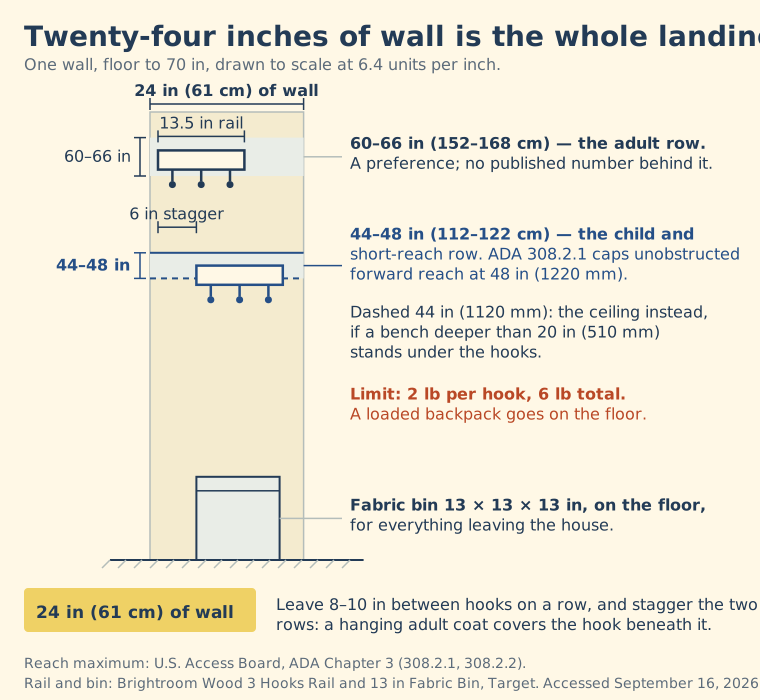
You need about 24 inches (61 cm) of wall, not a piece of furniture. One row of hooks at 60–66 in (152–168 cm) for adults, a second row at 44–48 in (112–122 cm) for children and short reaches, one shallow tray for pocket contents, one bin on the floor for things leaving the house. That is the whole landing place. Every part of it can come off a hallway wall, a bookshelf's bottom shelf, or a drawer you already own.
Two hook heights, and why the lower one stops at 48 inches
The upper row is a preference. Adults hang a coat comfortably somewhere between 60 and 66 in. The lower row is the one with a hard number behind it: the ADA standards set the unobstructed high forward reach at 48 in (1220 mm) maximum and the low forward reach at 15 in (380 mm) minimum above the floor. Put the child and short-reach row at 44–48 in and everyone in the house can use it.
The exception matters if a bench or console stands against the wall. Section 308.2.2 drops the maximum reach to 44 in (1120 mm) as soon as the reach depth exceeds 20 in (510 mm). A 20 in deep bench under your hooks puts the lower row at 44 in, not 48 in. Otherwise the backpack keeps landing on the floor and you keep calling it a discipline problem.
Leave 8–10 in between hooks on the same row so a winter coat does not sit on top of the next one. Stagger the two rows horizontally rather than putting the low hook directly under the high one, because a hanging adult coat covers the hook beneath it.
What a $15 rail actually holds
Weight limits are where these plans fail. Three options sold at Target, September 2026:
Scroll sideways to see the full table →
| Product | Size | Stated capacity | Price |
|---|---|---|---|
| Brightroom Wood 3 Hooks Rail | 13.5 in L x 3 in W x 3 in D, rubberwood, 3 pegs | 6 lb total, 2 lb per hook | $15.00 |
| Brightroom Wood Entryway Organizer with Mirror | 15 in L x 3.5 in W x 20 in H, 3 metal hooks | 20 lb total; shelf 11 lb; 3 lb per hook | $48.00 |
| Brightroom 13 x 13 in Fabric Decorative Storage Bin | 13 x 13 x 13 in, polyester over cardboard | Not stated | $10.00 |
Read the per-hook number, not the total. A 2 lb hook holds a canvas tote, a baseball cap, a dog leash or a light rain shell. It does not hold a loaded school backpack, a wool overcoat, or a gym bag with shoes in it. If what comes home with you weighs more than a couple of pounds, you want the 3 lb-per-hook organizer or a screw-mounted rail anchored into a stud, and a wall that gets drilled rather than one that gets adhesive strips.
The 13 in cube is the piece people forget. At $10 it is the cheapest way to bound the outgoing pile, and 13 x 13 x 13 in holds roughly a paper grocery bag's worth: library books, a package to ship, a bag of clothes. That is exactly the volume that otherwise spreads along the baseboard.
The four things a landing place has to hold
Every entryway that works holds the same four groups, in decreasing size:
- Keys and pocket contents. One shallow tray, 6–8 in across, on a surface between 30 and 40 in high. Shallow matters. A deep bowl swallows a key ring.
- Bags and outerwear. The hooks. One hook per person who comes through that door daily, plus one spare.
- Outgoing. One bin, on the floor, for returns, donations, library books and anything being handed to someone. Give each item in it a date and an owner, the way you would when you give outgoing donations and returns a next step.
- Paper. Mail that arrived today. A single vertical slot or a 2 in stack limit, emptied weekly, so it never migrates to the counter — the failure described in keeping household paperwork out of the kitchen.
Anything outside those four is long-term storage and belongs at its real home. Seasonal gloves in July are storage.
A worked example: 30 inches of wall next to a side door
A household of two adults and one eight-year-old uses the side door off the driveway rather than the front door. There is 30 in of blank wall between the door frame and a closet.
Mount two Brightroom 3-hook rails: one at 64 in for the adults, one at 46 in, offset 6 in to the right, for the child. That is six hooks, $30, and 27 in of the available 30 in used. Put a 6 in ceramic dish on the closet's top shelf ledge at 36 in for keys. Put a 13 in fabric bin on the floor directly under the low rail for outgoing items. Total spend: $40, no furniture, no drilling into the closet.
Respect the 2 lb per hook. The child's loaded backpack goes on the floor beside the bin, not on the rail, or the rail comes out of the drywall in a month. If it has to hang, that is the case for the $48 organizer with its 3 lb hooks, or for a stud-mounted rail.
Stand at the door you actually use. Name out loud the five things in your hands when you walk in, and the five you reach for on the way out. If those ten things do not fit the four groups above, you have found the objects that need a home elsewhere — start with the one that has resisted longest, using the reach test in choosing a home for an item that never gets put away. Then measure your wall, mark the two hook heights in pencil at 64 in and 46 in, and check the marks against the tallest and shortest people in the house before you drill anything.
Sources and references
- U.S. Access Board — ADA Standards, Chapter 3: Building Blocks (Section 308 Reach Ranges)Accessed 2026-09-16
- Brightroom Wood 3 Hooks Rail Natural — TargetAccessed 2026-09-16
- Brightroom Wood Entryway Organizer with Mirror — TargetAccessed 2026-09-16
- Brightroom 13"x13" Fabric Decorative Storage Bin — TargetAccessed 2026-09-16