
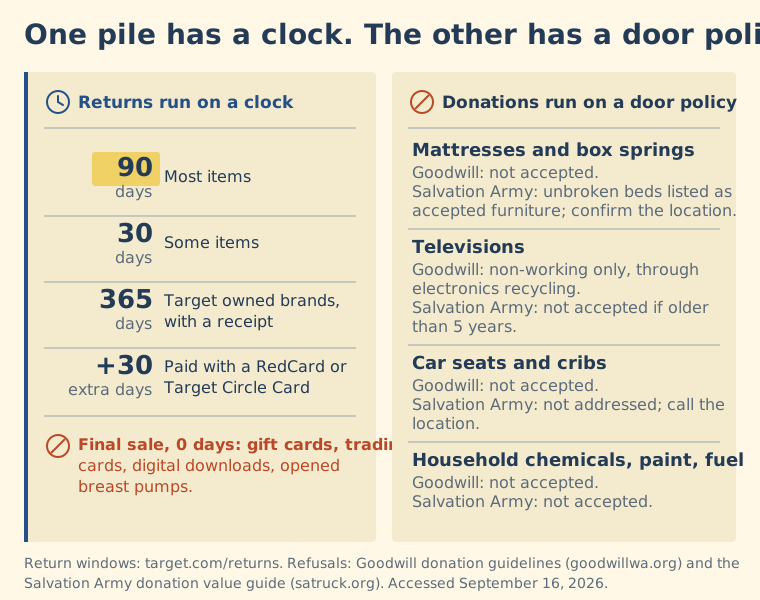
Handle returns first and donations second, because only one of them expires. The day a package you intend to send back arrives, put its last return date on a shared calendar — at Target that is 90 days for most items, 30 days for some, and 365 days for Target owned brands with a receipt, plus an extra 30 days when you pay with a RedCard or Target Circle Card. Donations have no clock. They do get turned away at the door, so check the refusal list before you load the car.
Returns expire, so the date goes on a calendar, not in your head
A pile by the door is a decision about an object. It is not a plan, and it does not preserve eligibility. Write three things in the calendar entry the day the item arrives: the retailer, the item, and the last day to return it.
Target's published policy shows why one number in your head will not do. Three different windows apply to different items, electronics and limited-time collections carry their own terms on the product page, and gift cards, trading cards, digital downloads and opened breast pumps are final sale. Other retailers run different clocks again, so read the policy for the specific order rather than assuming the last one applies.
Two rules follow. If you cannot establish the deadline from the order confirmation, write "deadline unknown" and make finding it the next action — today, not on trip day. And set the calendar entry a week before the real date. Return windows usually run from delivery, and a Saturday deadline you notice on Saturday afternoon is a deadline you miss.
What donation centers actually refuse
Acceptance rules differ by affiliate, and both national organizations say so outright. The refusal lists still overlap heavily, and a few categories come back at the door almost everywhere:
Donations have no clock, but they do have a door policy, and two categories beyond the ones on the card are refused on both lists: built-in appliances, where Goodwill will not take hardwired fixtures and the Salvation Army does not accept them at all, and large exercise equipment, which Goodwill does not accept while the Salvation Army lists sports equipment and bicycles but varies on large machines.
Sources: Goodwill donation guidelines and the Salvation Army donation value guide, both September 2026.
Past the categories, condition is what gets a bag rejected on the curb. Goodwill asks for items "in good working or sellable condition," and the Salvation Army will not take appliances that are broken or missing power cords. Anything mildewed, wet, stained or rusty comes back home with you. Batteries, light bulbs, printers and fax machines also sit on the Goodwill refusal list, which catches out most people clearing a home office.
Call the location before a trip involving furniture, appliances or electronics. Five minutes on the phone beats loading a sofa twice.
The $250 line where a receipt stops being optional
If you itemize deductions, the IRS requires a contemporaneous written acknowledgment from the charity for any single contribution of $250 or more, and that acknowledgment must describe the non-cash property and state whether the organization gave you any goods or services in return. IRS Publication 1771 adds that "separate contributions of less than $250 will not be aggregated," so four $100 drop-offs across a year do not trigger the rule.
At the donation door that turns into one habit. If the bag in your hands is plausibly worth $250 or more — a sofa, a bicycle, a laptop, a large lot of clothing — ask for the written receipt at the counter. Do not leave without it. For small drop-offs, take the blank slip if you want one and keep your own dated list of what was in the bag. That is the substantiation rule, not tax advice for your return.
One shelf, two labels, one trip
Give outgoing items a physical place with exactly two divisions, because donations and returns need different information attached:
- Returns. Keep the item, its box, and its packing slip together. Label the box with the retailer and the last return date. A return without its original packaging is often still accepted; a return without its order number usually is not.
- Donations. Bag by destination, not by category, because destinations have different refusal lists. Label each bag with the place it is going.
Both live in one named spot — the bottom shelf of a hall closet, or a 13 in bin in your entryway landing place. Assign one person and one day. "Saturday, Alex, two bags to the Goodwill on Route 9 and the Target return on the way back" is a plan. "We should drop this off" is not, which is the same distinction that makes one place for household actions work.
Then cap the shelf. When outgoing items stop fitting in the named spot, the trip happens that week. A physical boundary does the scheduling that intentions do not.
Go to the pile now and split it into two groups on the floor. For every return, open the order confirmation and write the last return date on the box in marker; anything past its window moves to the donation group or the trash immediately, so it stops occupying the shelf. For every donation, check the destination's refusal list for mattresses, car seats, batteries, printers and anything broken, and pull those out for recycling or disposal instead. Then pick a day. Name the driver. Put both stops on one calendar entry. Items you are still not ready to part with belong in a different task — give them their own dated box the way you would with sentimental belongings, and keep them off the outgoing shelf.
Sources and references
- Target Return PolicyAccessed 2026-09-16
- Donation Guidelines — Goodwill (goodwillwa.org)Accessed 2026-09-16
- Donation Value Guide — The Salvation Army Family StoresAccessed 2026-09-16
- Charitable contributions: Written acknowledgments — Internal Revenue ServiceAccessed 2026-09-16
- Publication 1771: Charitable Contributions — Substantiation and Disclosure Requirements — IRSAccessed 2026-09-16