
Five phrases on household packaging carry a legal definition, and they are the only ones worth reading: recyclable, degradable, compostable, free of, and recycled content. The FTC's Green Guides set what each has to mean before a marketer may use it unqualified. Everything else — "green," "eco-friendly," "earth-conscious," a leaf drawing — has no defined content, and the Guides say so themselves. Find which of those five words is on the package, then read the qualifier printed next to it. The qualifier holds the scope.
The five claims with a federal definition
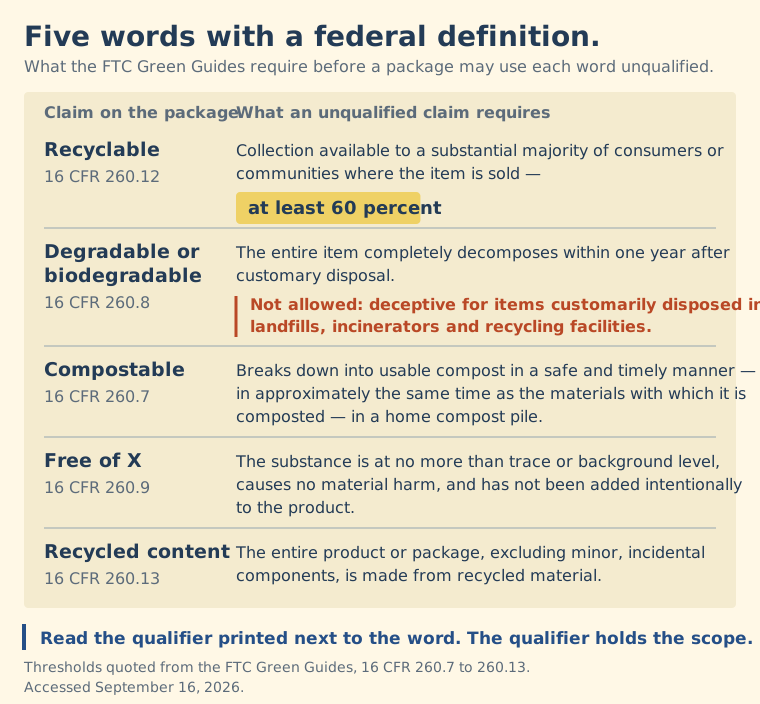
Two deserve a second look. The degradable rule effectively bars an unqualified "biodegradable" on anything you throw away normally: the Guides state it is deceptive for items "customarily disposed in landfills, incinerators, and recycling facilities" because those environments do not support complete decomposition within a year. The recyclable rule has a component trap — "if any component significantly limits the ability to recycle the item, any recyclable claim would be deceptive." A recyclable bottle with a pump that jams the sorter is not a recyclable package.
Why an unqualified "eco-friendly" tells you nothing
16 CFR 260.4 covers general environmental benefit claims, and its conclusion is unambiguous: "unqualified general environmental benefit claims are difficult to interpret and likely convey a wide range of meanings," so "marketers should not make unqualified general environmental benefit claims." The Guides' own remedy is to attach a specific benefit — "Eco-friendly: made with recycled materials" — and then substantiate that narrower claim.
Seals get the same treatment. 16 CFR 260.6 tells marketers not to use certifications or seals "that do not convey the basis for the certification," and to add "clear and prominent qualifying language that clearly conveys that the certification or seal refers only to specific and limited benefits." A green circle with a company's own invented wordmark in it is a general benefit claim wearing a badge.
What the three real certification marks actually certify
Three marks on American household products are run by federal programs. Each one certifies something narrow, and no two of them certify the same thing.
EPA Safer Choice is about ingredients and whether the product works. Products are evaluated against the Safer Choice Standard, which "identifies the requirements products and their ingredients must meet to earn the Safer Choice label," applying master and functional-class criteria so that certified products "contain only the safest possible ingredients." It also requires demonstrated performance against leading conventional brands, and packaging that meets section 4.2.6 of the standard. It is not a carbon or recycling claim.
USDA Certified Biobased Product is a content measurement and nothing more. The label "assures a consumer that the product contains a verified amount of renewable biological ingredients," measured by ASTM D6866, which "determines the ratio of a product's new organic carbon to total organic carbon, expressed as a percentage." USDA has set minimum thresholds for 141 product categories. The mark prints the percentage on it, and that percentage is the entire claim. It says nothing about toxicity, biodegradability or disposal.
ENERGY STAR is a measured efficiency threshold. A certified clothes washer uses "about 20% less energy and about 30% less water than regular washers," which works out to about 14 gallons of water per load against 20 gallons for a standard machine. Certification turns on two numbers, the Integrated Modified Energy Factor and the Integrated Water Factor, not on materials or chemistry.
Reading a real bottle: three claims, three different objects
Seventh Generation's Free & Clear liquid laundry detergent page carries three environmental statements at once, and they point at three separate things:
- "USDA Certified Biobased Product 97%" — about the formula's carbon origin, verified by carbon dating, and measured to a stated number.
- "EPA Safer Choice Certified" — about which ingredients are in that formula and how it performs, not about how much of it is plant-derived.
- "Recyclable Packaging" — about the bottle, not the formula, and subject to the 60 percent availability test in 260.12.
Each claim names its object. Now apply the same test to a package that says "97% natural" with no mark, or "recyclable" with no material named: which part of what you are buying does this describe, and who checked? For recycled content, 260.13 makes the scope rule explicit — a claim limited to the paperboard box is fine, while the same claim applied to the whole multi-part package is deceptive without qualification.
What to look for on the next bottle you pick up
Turn the package over and find the small print. That is where the qualifier lives. Look for three things in order: the noun the claim attaches to (bottle, carton, formula, pump), the number attached to it (97 percent biobased, 25 percent post-consumer recycled), and the name of the body that verified it (EPA, USDA, ENERGY STAR). A claim with all three is checkable. A claim missing the noun is a scope problem, a claim missing the number is a magnitude problem, and a claim missing the verifier is a general benefit claim that 260.4 says should not have been made unqualified in the first place. Note the mark and percentage in your household reference folder alongside the product name, so a repurchase takes ten seconds. And keep the environmental claim separate from the value comparison, which runs on package size and unit price rather than on the leaf on the front.
Sources and references
- 16 CFR § 260.12 — Recyclable claimsAccessed 2026-09-16
- 16 CFR § 260.8 — Degradable claimsAccessed 2026-09-16
- 16 CFR § 260.7 — Compostable claimsAccessed 2026-09-16
- 16 CFR § 260.9 — Free-of claimsAccessed 2026-09-16
- 16 CFR § 260.13 — Recycled content claimsAccessed 2026-09-16
- 16 CFR § 260.4 — General environmental benefit claimsAccessed 2026-09-16
- 16 CFR § 260.6 — Certifications and seals of approvalAccessed 2026-09-16
- Safer Choice Standard — US EPAAccessed 2026-09-16
- About the USDA BioPreferred ProgramAccessed 2026-09-16
- ENERGY STAR Certified Clothes WashersAccessed 2026-09-16
- Liquid Laundry Detergent – Free & ClearAccessed 2026-09-16