
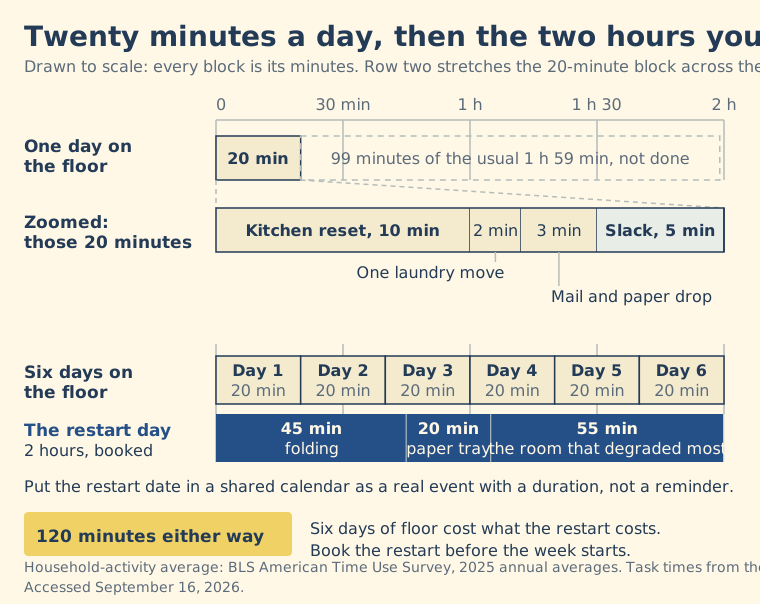
When the week fills up, keep a 20-minute daily floor and suspend everything else until a restart date you write down before the week starts. The floor is three things: a kitchen reset, one laundry move, a mail drop. Twenty minutes is roughly one sixth of the 1 hour 59 minutes a day US adults average on household activities — small enough to survive a 12-hour day, large enough that the house does not need a recovery weekend afterward. Run the floor for stretches of up to about 10 days. Past that, hand specific tasks to another person or to a service, because the deferred pile grows faster than one restart session can clear.
What two hours a day is made of
The Bureau of Labor Statistics American Time Use Survey put 2025 household activity at 1 hour 59 minutes a day on average. The largest pieces were 43 minutes of food preparation and cleanup, 34 minutes of housework, 11 minutes of lawn and garden care, and 10 minutes of household management such as bills and scheduling, with the remainder spread across interior upkeep, pet care and similar categories. Among people who did any household work at all, women averaged 2.8 hours and men 2.1 hours.
Cutting from 119 minutes to 20 drops about 99 minutes of household work a day. Across a six-day crunch that is close to 10 hours. Name the number anyway. Most of those hours are work that simply did not happen rather than a queue waiting to be cleared, but the restart day still needs a budget of its own or the plan fails on the far side.
The three tasks that stay, and what they cost
- Kitchen reset, about 10 minutes. Dishes into the dishwasher, counters wiped, one surface clear for tomorrow morning. Food preparation and cleanup is the largest household category in the ATUS data, and the one that compounds fastest when skipped. Fix the scope once and it stops being a nightly argument: choose a small end-of-day reset.
- One laundry move, about 2 minutes. Washer to dryer, or dryer to basket. Folding is suspended for the week. One move a day keeps the machines from becoming the blockage.
- Mail and paper drop, about 3 minutes. Recycling straight into the bin, everything else into one tray. No sorting, no decisions. The decisions happen on the restart day, and a single defined landing spot is what makes that survivable: see keeping household paperwork out of the kitchen.
That leaves about five minutes of slack, which is the point. A floor with no slack gets abandoned the first time something runs long.
Hand tasks to an institution before you hand them to a person
Some work leaves the household entirely for the length of the week. Mail is the clearest case. USPS Hold Mail pauses delivery for a minimum of 3 days and a maximum of 30 days, can be scheduled up to 30 days in advance, and must be requested by 3 a.m. Eastern on the day you want it to start. For an absence longer than 30 days, USPS points you to forwarding instead. A hold turns a daily task into zero tasks and keeps an overflowing mailbox out of the restart pile.
Grocery delivery does the same for the shopping trip, as long as the list is already written. When the list lives in people's heads, the ordering becomes the chore, so keep a running replenishment list somebody else can order from.
Decide each task once, not every evening
Write the decision down before the week starts. Then nothing needs re-deciding at 9 p.m., when the answer is always "skip it."
Scroll sideways to see the full table →
| Task | Normal cadence | Busy-week decision | Restart trigger |
|---|---|---|---|
| Kitchen reset | Daily | Keep, 10 minutes, no deep cleaning | Not deferred |
| Laundry | Two or three loads a week | One machine move a day, folding suspended | Restart day, allow 45 minutes |
| Mail and paper | Daily sort | Recycle and drop in one tray, or place a USPS hold | Restart day, allow 20 minutes |
| HVAC filter check | Monthly | Keep, it takes 5 minutes | Not deferred |
| Bathroom clean | Weekly | Sink and mirror only | Restart day |
| Drawer or closet sorting | Occasional | Suspend entirely | Next full weekend, not restart day |
The filter row is there on purpose. ENERGY STAR's maintenance checklist says to inspect, clean or change air filters once a month in a central air conditioner, furnace or heat pump, and to schedule an annual contractor check-up before the heating or cooling season. A five-minute task with a manufacturer-style interval behind it stays in the floor. A discretionary sorting project does not.
Book only three quarters of the day
University of Georgia Extension's time-management guidance recommends limiting scheduled time to about three quarters of your day and leaving the rest unscheduled. That maps straight onto a compressed week: with 90 free minutes on Wednesday, plan for about 65 and let the rest absorb the overrun. The same guidance suggests logging what you actually do in 15-minute intervals for a week or two before concluding where the time goes — a better first move than redesigning a routine from a guess.
Put the restart on a weekend day. In the 2025 ATUS results, 40% of people did housework on an average weekend day against 35% on an average weekday, so a Saturday or Sunday restart runs with the grain of how households already work.
Pick the date now. Put it in a shared calendar as a real event with a duration, not a reminder. Two hours is realistic for a six-day suspension: roughly 45 minutes of folding and putting away, 20 minutes on the paper tray, the rest on whichever single room degraded most. Write the three suspended items in the event body so you are not reconstructing the list from the mess. If the restart date slips twice, stop calling it a busy week. It is the new baseline, and the fix is to cut or reassign tasks permanently rather than keep deferring them.
Sources and references
- American Time Use Survey, Table 1: Time spent in primary activities (2025 annual averages)Accessed 2026-09-16
- American Time Use Survey news release, 2025 resultsAccessed 2026-09-16
- USPS Hold Mail serviceAccessed 2026-09-16
- ENERGY STAR HVAC maintenance checklistAccessed 2026-09-16
- Time Management: 10 Strategies for Better Time Management (University of Georgia Extension, C1042)Accessed 2026-09-16